

Business continuity and operational resilience, rehearsed and proven.
FalconryResilience connects critical services, dependencies, continuity plans, recovery strategies, scenarios, exercises, incidents and lessons learned—so resilience leaders can demonstrate that the organisation is ready, not merely documented.
Request DemoPlans do not prove resilience. Connected evidence of readiness does.
Many organisations maintain continuity plans, impact assessments, crisis procedures and recovery documents in separate repositories. When dependencies change or a disruption occurs, leaders need to know whether critical services can actually stay within tolerance—and whether actions from exercises and incidents have been closed.
Criticality is fragmented
Business impact, technology recovery and supplier dependency views are often maintained separately.
Plans age quietly
Recovery plans can remain technically current while the services, owners and dependencies beneath them change.
Exercises become events
Lessons are captured after tests, but actions are not always linked back to the risks and plans they should improve.
Executives lack one readiness view
Reporting is assembled manually from separate BCM, ITDR, incident and operational data sources.
Resilience as an operating system. Not a document library.
FalconryResilience connects the services the organisation must protect to the resources they depend on, the disruption scenarios they face, the strategies and plans that support recovery, and the evidence generated through exercises and real incidents.
From critical service to tested recovery—without losing the chain.
FalconryResilience supports the full resilience lifecycle while keeping tolerances, dependencies, plans, scenarios, exercises, incidents and improvement actions connected.
The same record can connect BIA, RTO/RPO, suppliers, sites, applications, crisis roles, communications, recovery procedures, exercises, incidents, lessons learned and management reporting.
Operate continuity and resilience as one connected readiness discipline.
Identify critical services
Define important business services, owners, customers, criticality and the outcomes that must be protected.
CRITICAL SERVICESUnderstand impact & tolerances
Run BIA, define RTO/RPO and impact tolerances, and connect those requirements to recovery priorities.
BIA & TOLERANCESMap dependencies
Connect services to applications, infrastructure, people, facilities, suppliers, data and other enabling resources.
DEPENDENCY MAPPINGMaintain continuity plans
Govern strategies, plan ownership, review cycles, recovery procedures and readiness evidence.
BCP & RECOVERYExercise & test readiness
Plan scenarios, exercises and technology recovery tests with objectives, participants, outcomes and lessons learned.
EXERCISES & TESTINGManage incidents & improvement
Track disruption, response, recovery, lessons, remediation and closure evidence from one resilience record.
INCIDENTS & IMPROVEMENTSee readiness through the services, dependencies and recovery evidence that matter.
These views illustrate four common working contexts across the proposition.

See which critical services are ready—and where tolerance is at risk.
Bring service criticality, tolerance, plan health, exercise results and unresolved actions into one executive readiness view.
- Critical-service posture
- Tolerance and readiness gaps
- Priority remediation
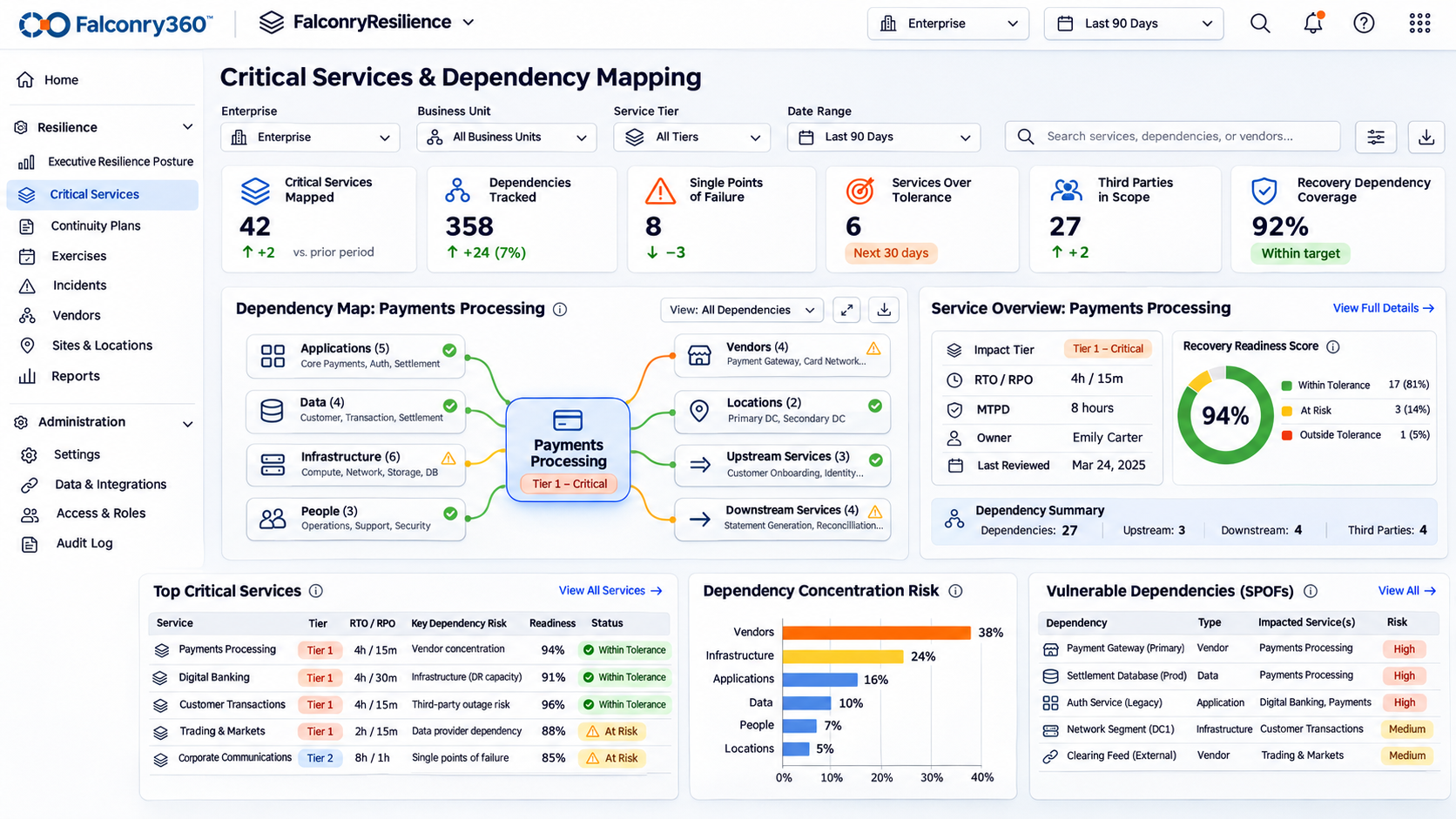
Know what each critical service depends on before disruption exposes it.
Map applications, people, facilities, suppliers and data to services, then compare recovery capabilities against impact tolerances.
- Service-to-resource mapping
- Single points of failure
- Recovery capability vs tolerance
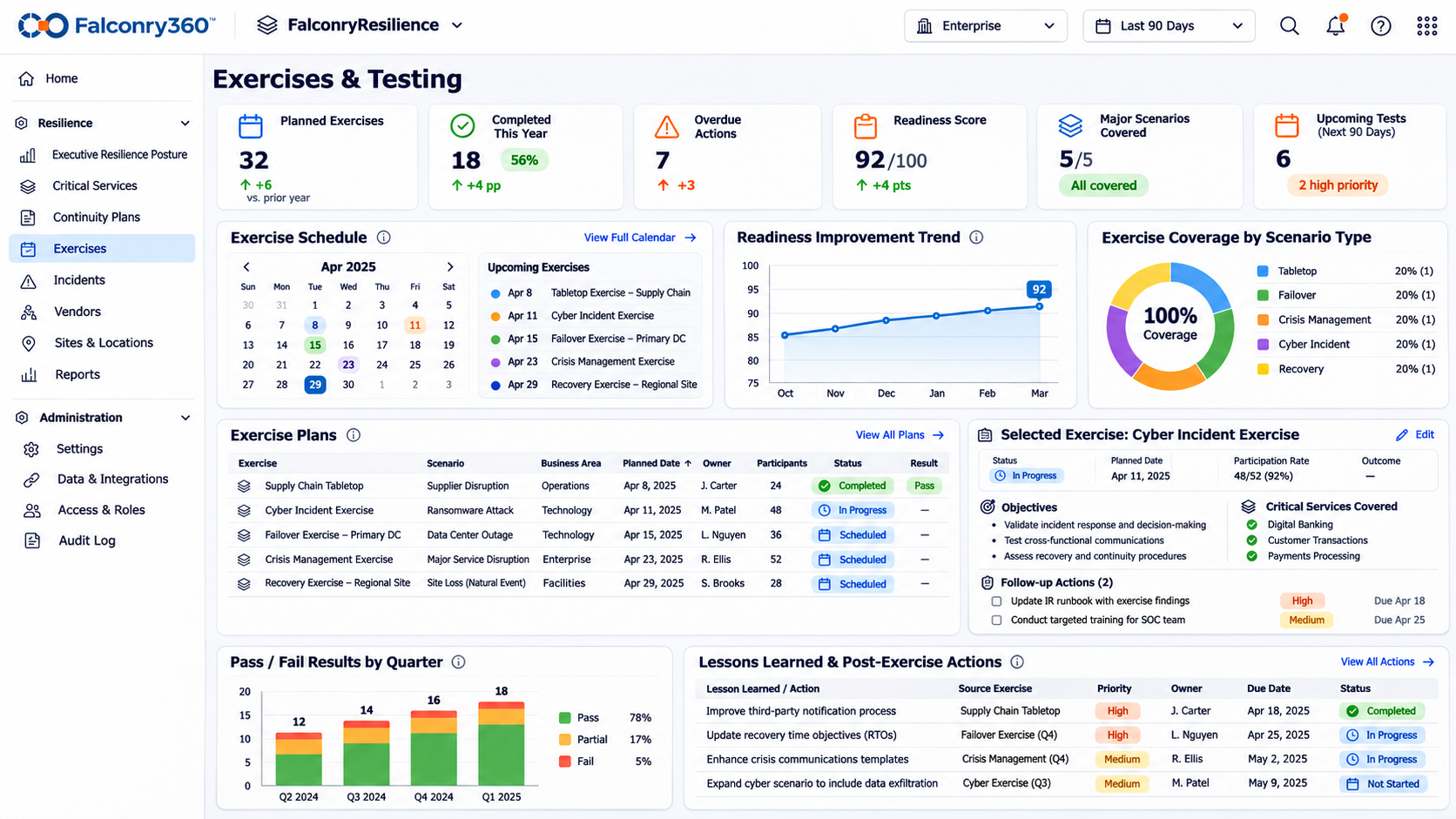
Turn testing into evidence of readiness—not a calendar event.
Run tabletop, simulation and recovery exercises against defined objectives, scenarios, tolerances and expected outcomes.
- Scenario and objective design
- Exercise evidence and results
- Lessons and action tracking
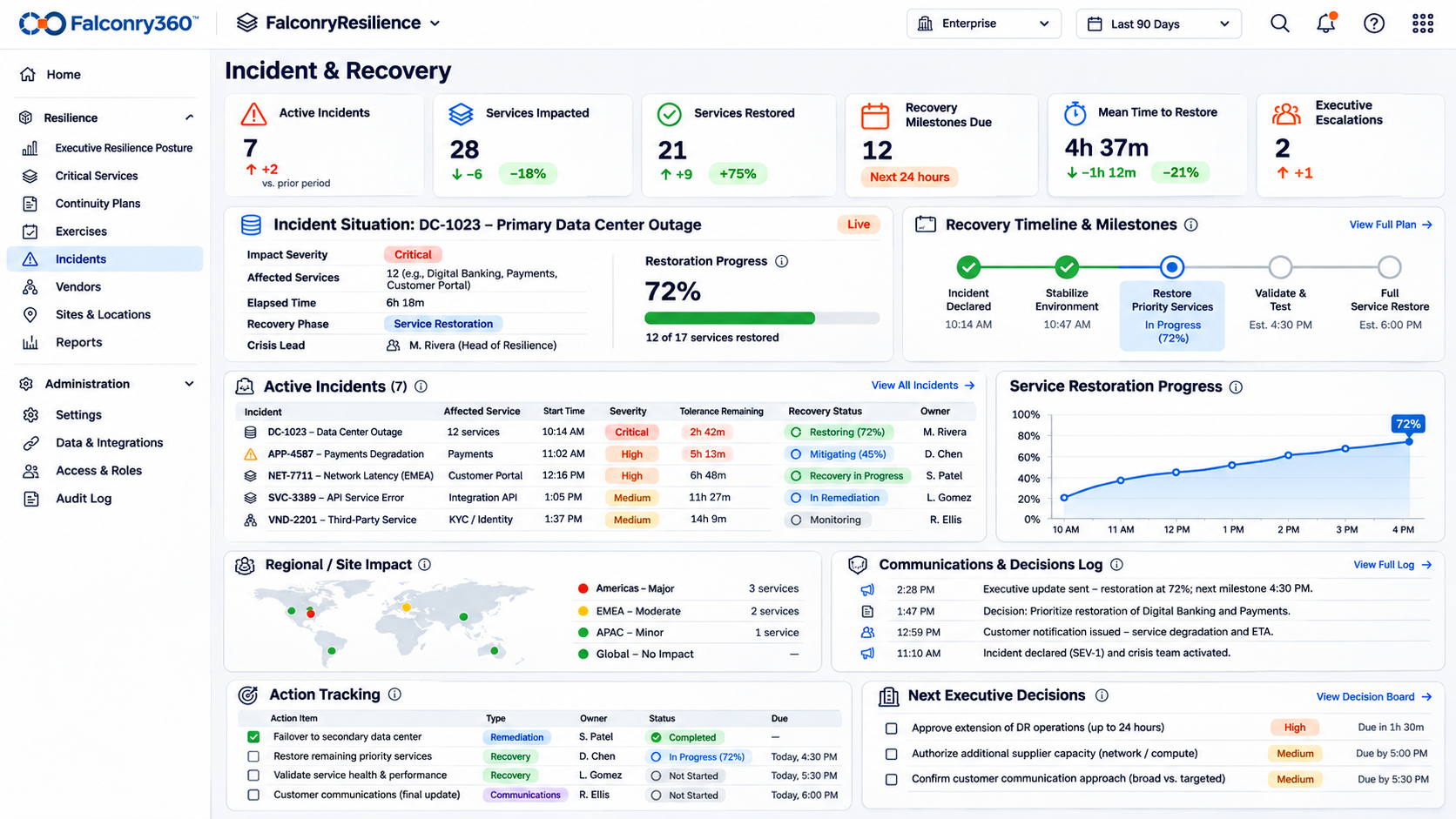
Manage recovery against the service outcomes and tolerances already defined.
Connect the disruption to affected services, response decisions, recovery milestones, lessons learned and accountable improvement actions.
- Impact and recovery tracking
- Crisis roles and decisions
- Lessons learned through closure
 FalconryX · Inside Falconry360
AI that helps resilience teams see what changed before the next disruption.
FalconryX works across governed service, dependency, plan, exercise and incident data to help identify readiness gaps, summarise impact, analyse lessons and prepare decision-ready resilience reporting. Human review and operational judgement remain central.
Resilience is stronger when service dependencies can see the wider risk, trust and assurance environment.
FalconryResilience shares governed records with adjacent propositions so critical services, controls, cyber risks, audit findings and remediation do not need to be recreated.
Connect enterprise risk, controls and remediation to operational resilience priorities.
Connected propositionFalconryAuditBring continuity, ITDR, exercises and recovery evidence into risk-based assurance.
Connected propositionFalconryTrustConnect cyber incidents, technology risks and third parties to service resilience.
Connected propositionFalconryCultureLink policy, training and role readiness to crisis and continuity responsibilities.
Connected propositionFalconryAwareUse human-risk and incident reporting signals where they affect resilience readiness.
Support continuity and resilience obligations across regional and global requirements.
FalconryResilience can structure service, impact, recovery, exercise and evidence requirements around the resilience frameworks and regulatory expectations relevant to the organisation. The examples below are representative rather than exhaustive.
Representative resilience priorities—not the limit of the proposition.
FalconryResilience supports a broad range of continuity and operational resilience priorities. These areas illustrate common starting points rather than defining the limits of the operating model.
Business impact analysis
Identify critical activities, impacts, recovery requirements and tolerances through governed BIA.
Critical-service resilience
Connect services, tolerances and dependencies to the capabilities needed to remain within acceptable disruption.
BCP & recovery planning
Maintain strategies, plans, ownership, review cycles and recovery procedures in one governed environment.
IT disaster recovery
Connect applications, infrastructure, RTO/RPO, failover tests and unresolved recovery gaps.
Scenario exercises
Design and evidence tabletop, simulation and recovery tests against material disruption scenarios.
Incident & crisis improvement
Turn disruptions and exercises into accountable lessons, remediation and demonstrable readiness improvement.
See whether your critical services are ready for disruption—not just documented for it.
Explore FalconryResilience against your services, dependencies, recovery requirements and testing programme.