
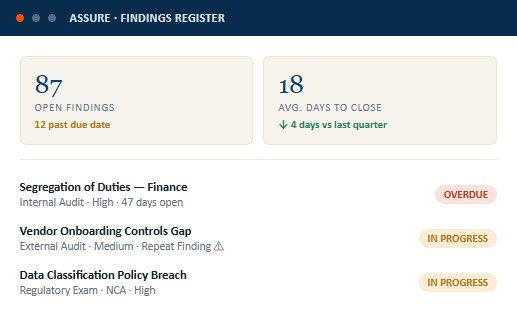
Across all assurance sources
Past agreed remediation date
↓ 4 days vs last quarter
Same root cause as prior finding
Internal audit, external audit, regulatory examination, self-identified — every finding in one place, with one process for management response, remediation, and closure.
Every issue from every assurance source — internal audit, external audit, regulatory examination, and self-identification — captured in a single register with consistent classification, severity, and ownership.
Classify every issue by root cause category — people, process, technology, or governance — so remediation targets the real problem and repeat issue detection identifies systemic failures.
Escalate overdue actions automatically based on finding priority and elapsed time. Flag repeat findings the moment a new root cause matches a historical pattern — before the same gap is raised a third time.
Falconry360 turns findings into owned, tracked, evidenced remediation — so every finding either closes or escalates. Nothing goes quietly past-due.
Capture findings from internal audit, external audit, regulatory examinations, and self-identified issues in one register — with consistent classification, priority, ownership, and audit trail regardless of source.
Classify the root cause of every finding — people, process, technology, or governance — so remediation targets the actual cause, not the symptom. Used for pattern analysis and repeat finding detection.
Build structured corrective action plans directly in the finding record — with sub-tasks, owners, due dates, and evidence requirements — and route for management approval before tracking begins.
Trigger escalation notifications automatically when a finding or action passes its due date — calibrated to finding priority — so overdue items reach management before they reach the auditor.
Require evidence uploads for every action before closure is possible. Route completed actions for independent verification — by internal audit or management — before the finding is formally closed.
Automatically flag new findings that share a root cause, business area, or control with a finding raised in a prior audit cycle — giving the CAE and audit committee visibility into systemic control failures.
Three screens — the consolidated findings register your assurance function manages, the individual finding detail your management team remediates, and the analytics dashboard your audit committee monitors.
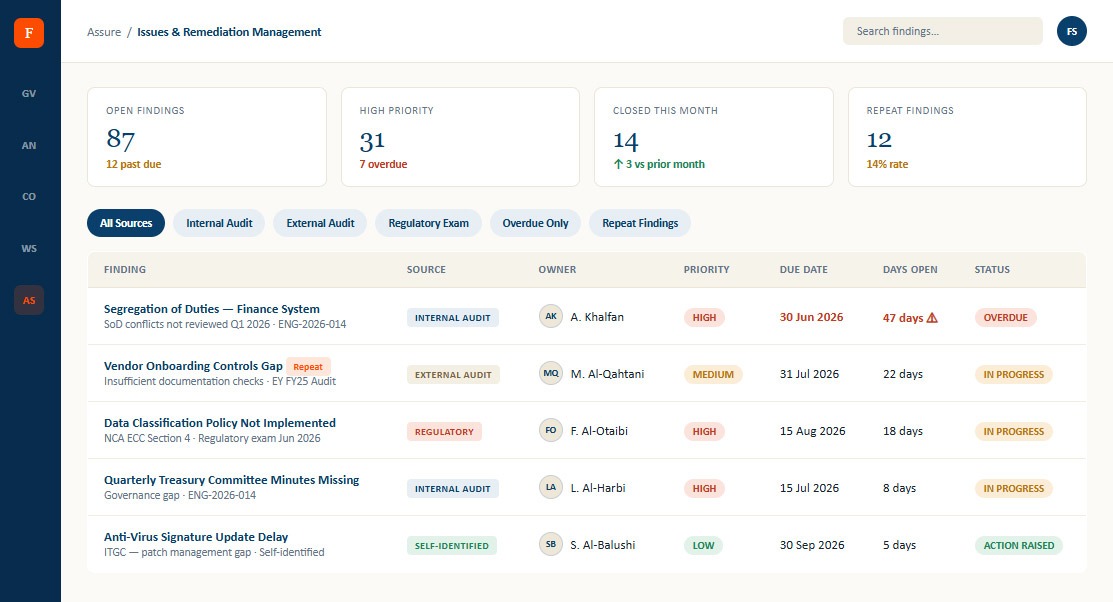
Every open finding — internal audit, external audit, regulatory exam, self-identified — in one prioritised register with source, age, owner, and status visible at a glance.
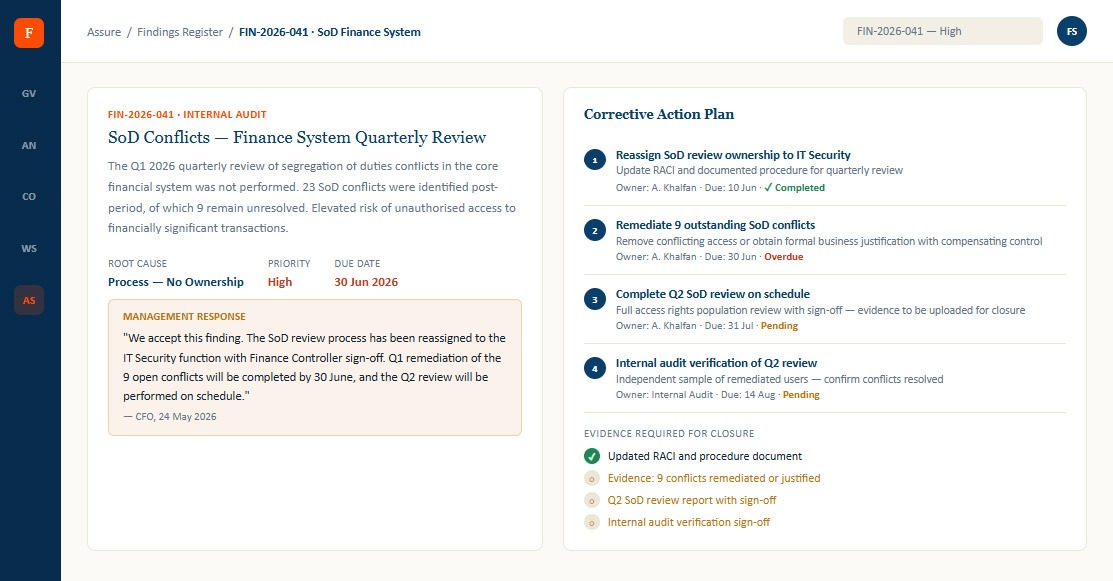
Drill into a high-priority finding — root cause, management response, corrective action plan, evidence requirements, and closure status.
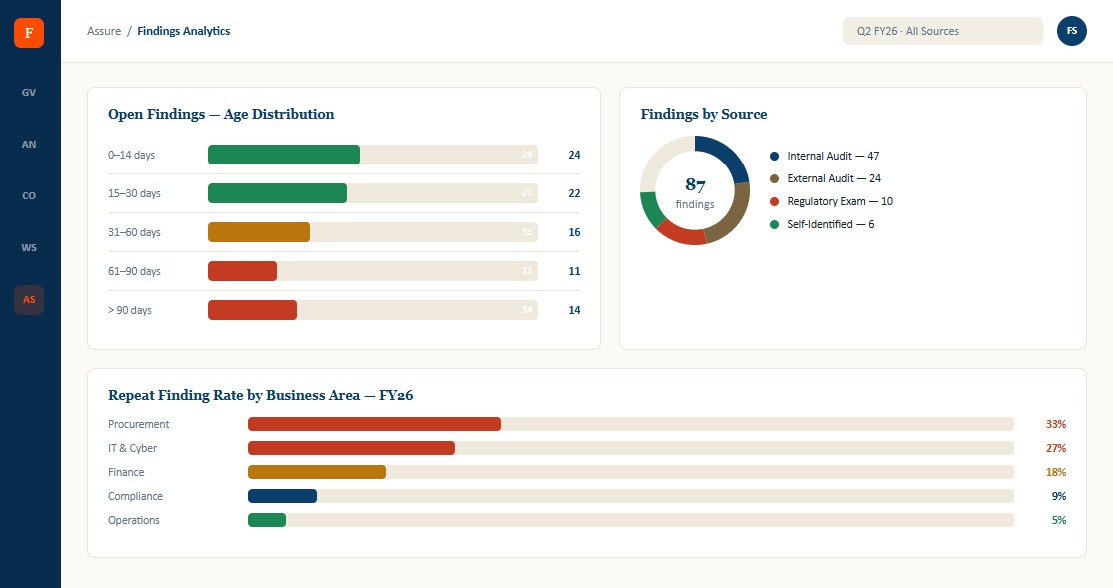
The view your CAE presents to the audit committee — aging analysis, closure rate trends, findings by source, and repeat finding rate by business area.
Log from any source — internal audit report, external audit letter, regulatory exam, or self-identified — with consistent classification, priority, and root cause.
Categorise the root cause — people, process, technology, or governance — so management targets the actual cause and the finding doesn't recur.
Route the finding for management acknowledgment, management response, and an approved corrective action plan — before the clock on the due date starts.
Track every corrective action to completion, require evidence uploads before closure is possible, and escalate automatically if any action becomes overdue.
Route completed findings for independent verification before formal closure — and flag to the audit committee any finding that cannot be closed on time.
One register for every finding source — internal audit, external audit, regulatory, self-identified — with one consistent process
Automatic escalation means overdue actions reach management before they reach the auditor
Evidence of remediation required before any finding can be closed — no self-certification
Repeat finding detection identifies systemic control failures before the next audit cycle
FalconryX root cause pattern analysis — identifying whether the same underlying failure is driving multiple findings
© 2026 Falconry360 . All rights reserved.