
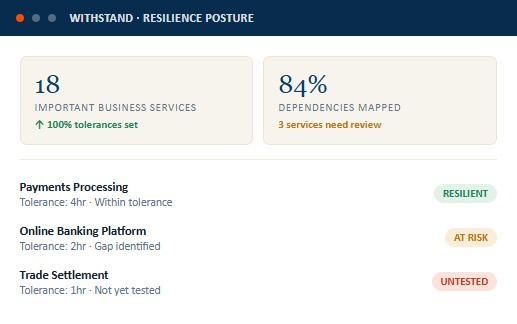
All with defined impact tolerances
Resources mapped to services
Services passing scenario tests
Requiring remediation plan
Important business service identification, dependency mapping, impact tolerance testing, and regulatory self-assessment — in one connected platform.
Define and manage your critical services with structured impact tolerances — aligned to FCA/PRA PS21/3, DORA, NCEMA, and ISO 22301 expectations.
Map every technology system, team, facility, and third-party vendor that each critical service depends on — so a disruption's blast radius is never a surprise.
Test whether each service can stay within its impact tolerance through scenario exercises — and produce the regulatory self-assessment at the end.
Operational resilience is not a continuity plan in a drawer. It's a demonstrated, tested capability — and Falconry360 builds and maintains that capability year-round.
Define and maintain a structured register of all important business services — with description, owner, regulatory classification, and impact tolerance for each.
Set maximum tolerable disruption durations for each service, expressed in time — aligned to FCA/PRA PS21/3, DORA Article 24, NCEMA, and ISO 22301 requirements.
Map the technology, people, facilities, data flows, and third-party providers that each service depends on — so you understand the full impact of any single-point failure.
Run structured scenario tests to verify that each service can continue operating within its tolerance under plausible disruption scenarios — and document the evidence.
Produce regulator-ready self-assessments — NCEMA operational resilience, FCA/PRA mapping and testing evidence, DORA ICT risk documentation — from a single data source.
Identify gaps where a service cannot meet its tolerance, assign remediation owners, track progress, and re-test until the gap is closed — with a full audit trail.
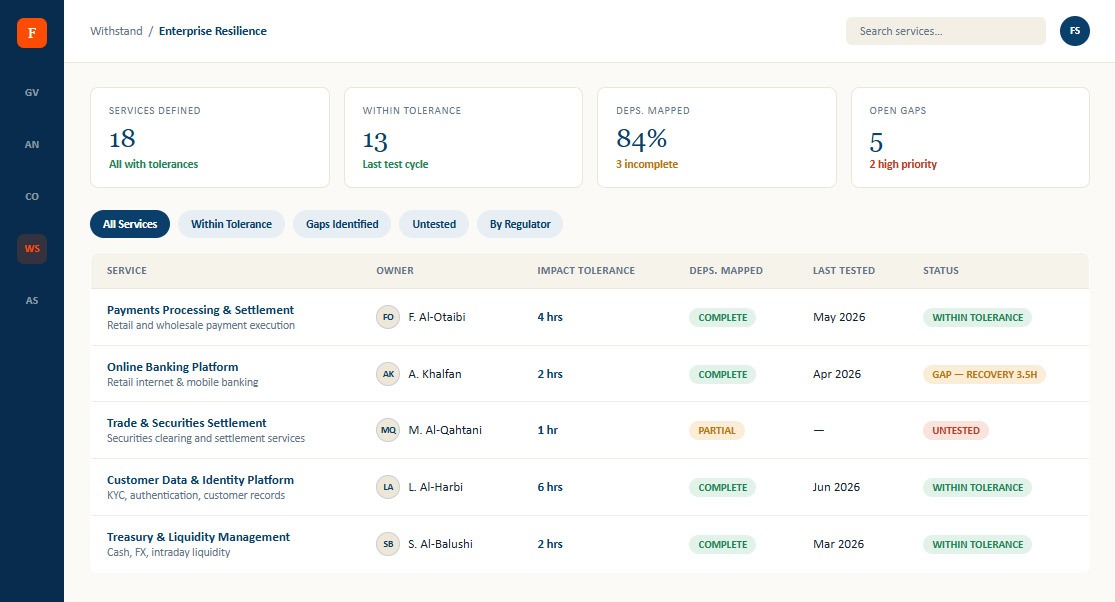
Three screens — the IBS register your resilience team maintains, the dependency map your assessors use for scenario testing, and the posture dashboard your board reviews.
Every critical service, its owner, defined impact tolerance, dependency completeness, and current resilience status — filterable by regulator, domain, or test outcome.
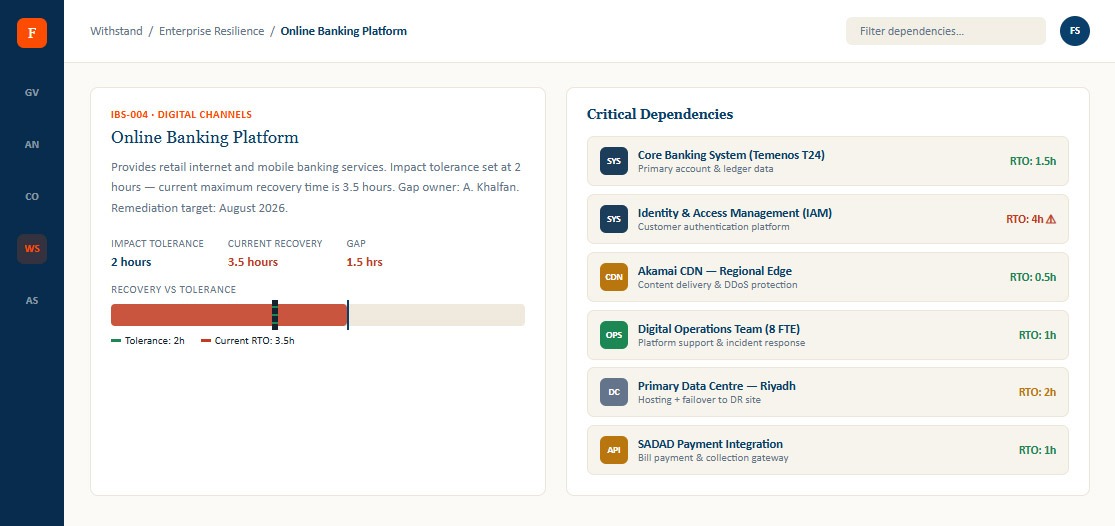
The full dependency chain for Online Banking — every technology system, team, facility, and vendor it relies on — with individual recovery capability vs. tolerance.
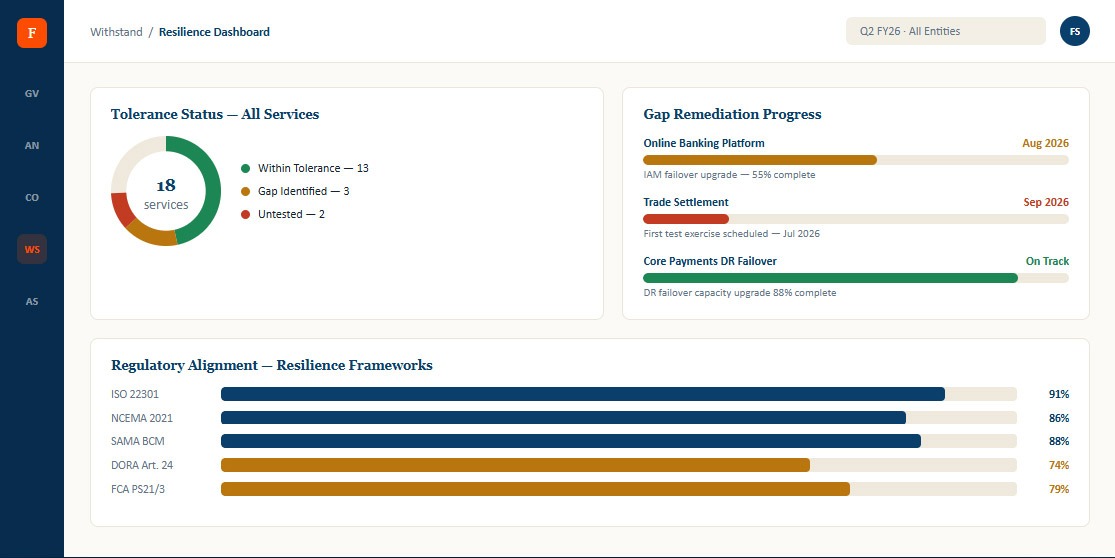
Board and regulator view — overall resilience posture, tolerance status across all services, and gap remediation progress.
Identify important business services using structured criteria — customer impact, regulatory scope, revenue dependency — across all entities.
Define the maximum tolerable disruption duration for each service, approved at the right governance level and aligned to regulatory expectation.
Identify every technology system, team, facility, data flow, and vendor each critical service depends on.
Run structured scenarios against each service to verify it stays within tolerance — and document the evidence for regulators.
Where gaps are found, assign remediation plans with owners and target dates — and re-test until tolerance is met.
Important Business Services framework aligned to FCA/PRA PS21/3, DORA, ISO 22301, and GCC regulators
Dependency maps that reflect real infrastructure — not a one-time PowerPoint diagram
Scenario testing evidence produced at the end of every exercise — regulator-ready, automatically
Live resilience posture score across all services — not a point-in-time self-assessment
FalconryX-assisted scenario generation based on real threat intelligence and historical incident data
© 2026 Falconry360 . All rights reserved.