
Pre-built — internal fraud through to physical damage
NCA, SAMA, ISO 27001, NIST CSF & more
ISO, NIST, SAMA, NCA, PDPL & more
First-line self-assessment, second-line challenge
Identity, Infra, Endpoint, Data, Cloud, Third-Party
Controls shared across 2+ frameworks
Every loss event tied to the process and control that failed
CVSS · EPSS · KEV-aware prioritisation
Requirements mapped to a control
Losses, KRIs, and RCSA in one board pack
Shared taxonomy, shared severity scale
Requirements without a control
Stop assembling the quarterly operational risk pack from four disconnected spreadsheets. One workflow, one taxonomy, one feedback loop.
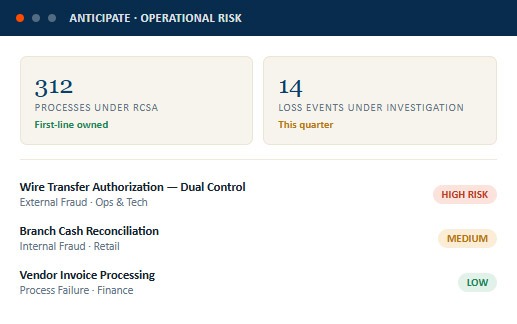
Every business process risk-assessed by the first-line owner, challenged by the second line, scored on inherent and residual likelihood and impact.
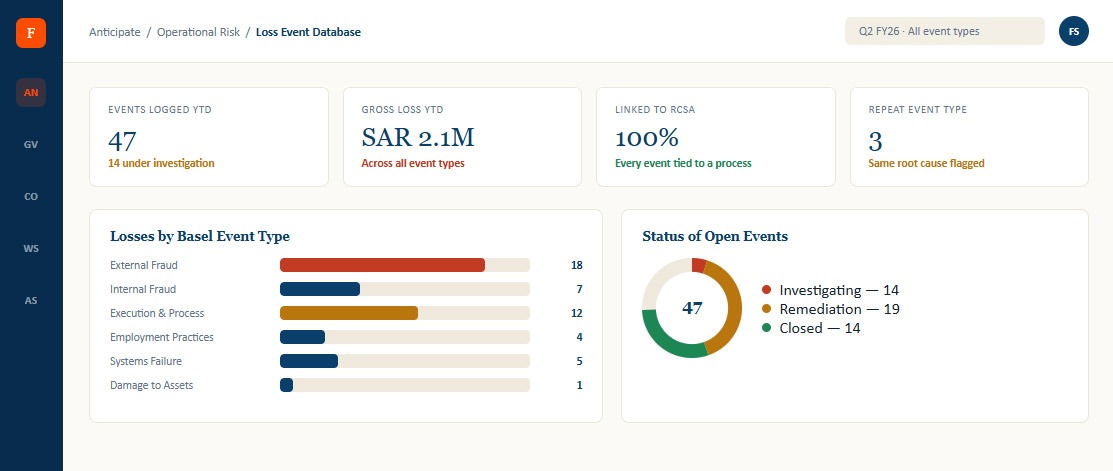
Every loss and near-miss captured with severity, frequency, and Basel II classification — then linked to the process and control that failed.
A loss event tells you what already happened. A KRI tells you it's about to. Falconry360 correlates both and escalates before the next incident.
Six connected capabilities that turn RCSA, loss events, and KRIs into one coherent operational risk programme — not three disconnected spreadsheets.
Every business process risk-assessed by the first-line owner and challenged by the second line. High-risk processes surface automatically — not three months later.
The seven Basel event types pre-built — internal fraud, external fraud, employment practices, and the rest — so every loss is classified consistently from day one.
Key risk and control indicators tracked against thresholds, correlated with loss history, and escalated before the next event — not after.
Every loss and near-miss linked to the process and control that failed — so the same gap doesn't get rediscovered the hard way twice.
Loss history can't tell you about the failure that hasn't happened yet. Structured scenario workshops model low-frequency, high-impact events.
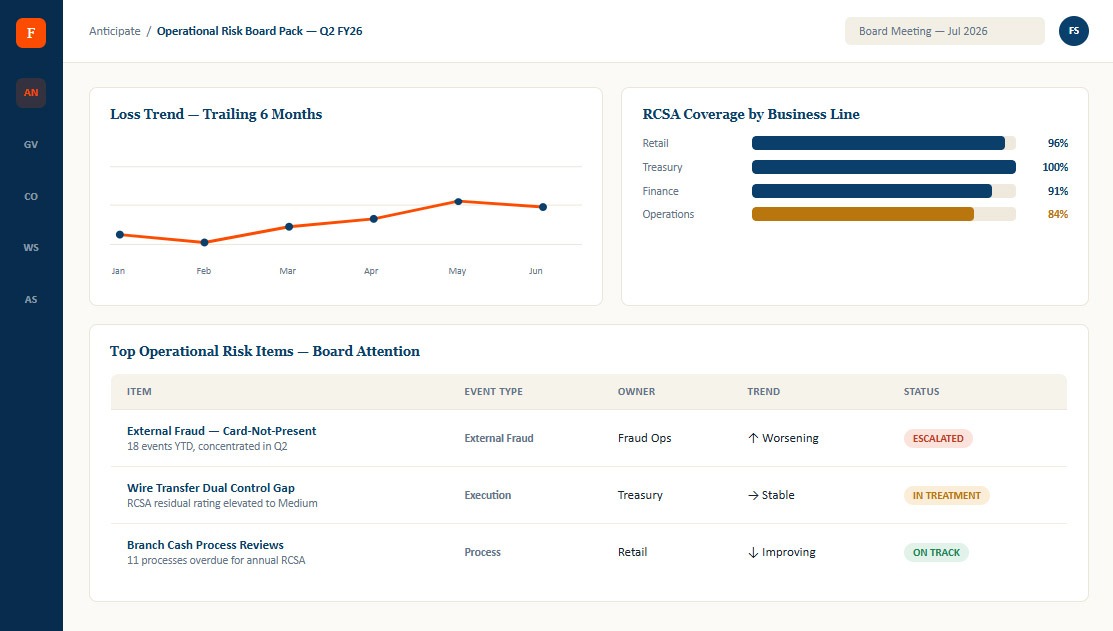
Loss trend, RCSA coverage, and KRI breaches tracked automatically — board pack drafted with FalconryX narrative, evidence already attached.
Three screens the RCSA register your first line works in, the Basel-classified loss event database, and the board pack that integrates losses, KRIs, and RCSA automatically.
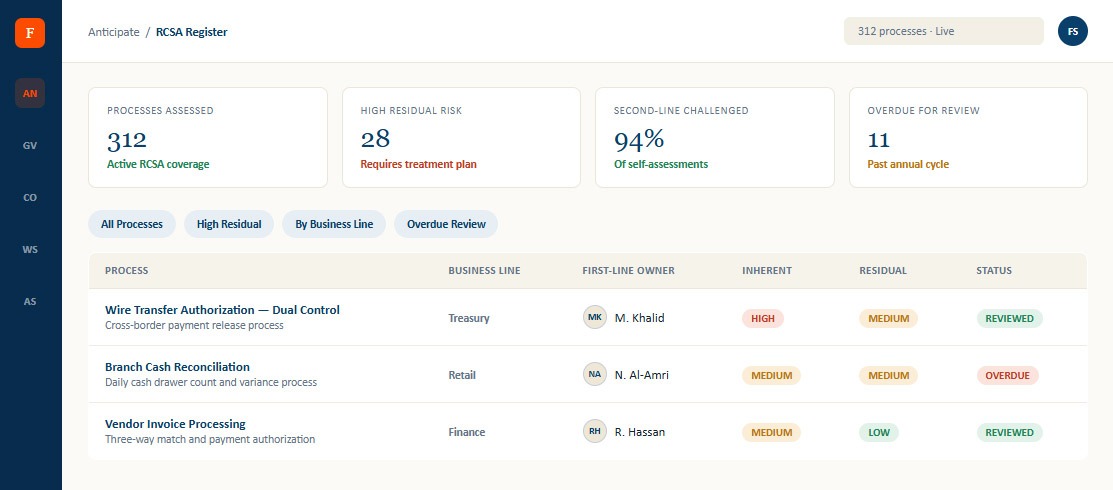
Every business process, risk-assessed by the first line and challenged by the second — with inherent and residual scoring visible at a glance.
Every loss and near-miss, classified by Basel event type and linked to the process and control that failed.
Loss trend, RCSA coverage, and KRI breaches integrated into one report — drafted automatically, evidence already attached.
First-line owners assess their process; second line challenges the rating. Inherent and residual risk both scored.
Every loss and near-miss classified against the seven Basel II event types — consistent from day one, audit-ready by design.
KRIs and KCIs tracked against thresholds, correlated with loss history, escalated before the next incident — not after.
Scenario workshops model the low-frequency, high-impact failure that hasn't happened yet — across operational, financial, and reputational lines.
Loss trend, RCSA coverage, and KRI breaches compiled automatically into one operational risk board pack.
RCSA, loss events, and KRIs share one register — not three disconnected spreadsheets
Basel II event-type taxonomy built in — classified consistently from day one
Leading KRIs correlated with loss history — escalation before the next event, not after
Every loss event linked back to the process and control that failed — the gap gets fixed, not rediscovered
FalconryX connects the loss event to the RCSA rating that missed it — and tells your team what to reassess
© 2026 Falconry360 . All rights reserved.