
NCA and SAMA-Aligned Cyber Governance: Building a Unified Operating Model for KSA

Saudi Arabia has become one of the most structured and demanding cyber regulatory environments in the region. The National Cybersecurity Authority (NCA) has issued a comprehensive suite of mandatory and sector-specific cybersecurity controls, while the Saudi Central Bank (SAMA) enforces its own Cyber Security Framework (SAMA CSF) for regulated financial institutions. For many organisations, 80–90% of the cyber governance and compliance workload is now directly tied to these two pillars. Managing NCA and SAMA requirements through scattered documents and point tools is no longer sufficient. What’s needed is a unified cyber governance operating model that embeds NCA and SAMA expectations into daily risk, compliance, and technology workflows. The NCA and SAMA Cyber Landscape in Brief NCA defines national baselines through: ECC (Essential Cybersecurity Controls – ECC‑1:2018 / ECC‑2:2024) – foundational, mandatory controls for government entities and critical national infrastructure. OTCC (Operational Technology Cybersecurity Controls) – specialised controls for ICS/SCADA and industrial environments. CCC (Cloud Cybersecurity Controls) – standards for cloud service providers and cloud-consuming organisations. DCC (Data Center Cybersecurity Controls) – controls for hosting facilities and data centres. CSCC (Critical Systems Cybersecurity Controls) – measures for systems vital to national security and critical services. NCNICC‑1:2025 – cybersecurity controls tailored for non‑CNI private sector entities, with a strong emphasis on governance, defence, and third‑party risk. In parallel, SAMA CSF provides a structured framework for financial institutions, covering governance, risk management, defence, resilience, and third‑party oversight across all critical systems and services. The combined effect: cyber is no longer just a technical matter—it is a regulated governance discipline. Why a Unified Cyber Governance Operating Model Is Needed Trying to comply with NCA and SAMA using separate spreadsheets, GRC tools, vulnerability platforms, and vendor trackers leads to: Duplicated controls and assessments – the same requirement implemented multiple times with slight variations. Inconsistent mappings – NCA and SAMA clauses linked to different controls in different systems. Limited traceability – difficulty showing regulators how a specific NCA/SAMA requirement is implemented, tested, and monitored across entities and third parties. A unified model should provide: One central control library aligned to NCA ECC, OTCC, CCC, DCC, CSCC, NCNICC‑1 and SAMA CSF. A single view of critical assets, services, and vendors, mapped to those controls. Integrated workflows for risk assessment, implementation, monitoring, incidents, and issues. Structuring NCA and SAMA Controls in Falconry360 In Falconry360, NCA and SAMA expectations can be embedded as part of the COMPLY and ANTICIPATE layers and reused across entities: Control Library Alignment Build a canonical cyber control library mapped to NCA ECC families and SAMA CSF domains. Add specialised control sets for OTCC, CCC, DCC, CSCC and NCNICC‑1 where relevant (e.g., OT environments, cloud, data centres, non‑CNI). Obligation and Clause Mapping Represent each NCA and SAMA requirement as a structured obligation. Map obligations to controls, assets, services, and third parties. Track coverage status and residual gaps. Entity and Sector Views Use tags and filters to distinguish government, CNI, financial institutions, and non‑CNI private sector entities. Provide entity‑specific dashboards showing NCA/SAMA coverage and outstanding actions. This ensures you are not “re‑implementing NCA” for each business unit; you are reusing one model across many contexts. Integrating Risk, Incidents, and Third Parties Cyber governance is not just about controls—it’s about how they relate to risks, events, and vendors. On a unified platform: Cyber risks are classified and assessed using a central taxonomy, with explicit links to NCA/SAMA control requirements. Incidents and breaches are logged with root causes, affected systems, and impacted controls, showing both NCA and SAMA implications. Third‑party assessments are structured around NCA and SAMA expectations (especially ECC, OTCC, CCC, DCC, NCNICC‑1 and SAMA’s third‑party requirements), so vendor posture can be compared consistently. This makes it easier to answer questions such as: “Which NCA/SAMA controls failed in this incident?” or “Which vendors create the highest aggregated compliance exposure?” Using FalconryX to Accelerate NCA/SAMA Alignment FalconryX can significantly reduce manual effort in KSA cyber governance by: Reading NCA and SAMA updates and suggesting new or changed obligations. Proposing control mappings between new clauses and your existing control library. Helping draft impact assessments, risk memos, and regulatory responses grounded in live platform data. Highlighting hotspots where incidents, weak tests, or open issues cluster around critical NCA/SAMA controls. This turns NCA and SAMA cyber compliance from a series of one‑off projects into a continuous, intelligence‑driven process. From Compliance Burden to Strategic Advantage When NCA and SAMA requirements are embedded inside the governance operating system: Compliance becomes demonstrable: you can show, not just claim, how each requirement is implemented and monitored. Cyber risk management becomes more strategic: leadership sees how cyber posture links to critical services and third‑party dependencies. Audit and supervisory interactions become more efficient: evidence, mappings, and history are all in one place. KSA institutions that invest now in NCA/SAMA‑aligned cyber governance as part of a unified operating model will be better positioned to scale, innovate, and respond to future regulatory evolution.
The 2026 CRO, CCO, and CISO: How Integrated Governance and AI Redefine Their Roles

The roles of Chief Risk Officer (CRO), Chief Compliance Officer (CCO), and Chief Information Security Officer (CISO) are converging in important ways. Each owns a piece of the organisation’s defense, yet regulators, boards, and customers increasingly expect a single, coherent view of risk and control. By 2026, integrated governance operating systems and AI‑enabled decision intelligence are reshaping what it means to be effective in these roles. From Siloed Leaders to a Risk and Control “Triad” Historically: The CRO focused on enterprise risk, capital, and risk appetite. The CCO focused on regulatory compliance, policies, and monitoring. The CISO focused on cyber, technology, and information protection. In practice, their worlds now overlap heavily: cyber incidents trigger regulatory issues; compliance failures reflect risk and control weaknesses; operational resilience ties them all together. In an integrated governance model: They operate as a triad, each with distinct accountability but shared data, language, and objectives. They jointly shape risk appetite, control strategy, and resilience priorities. They present unified narratives to boards and regulators, supported by a common platform. How a Governance Operating System Changes Their Daily Work With a platform like Falconry360: The CRO sees a real‑time risk picture that incorporates cyber, privacy, third‑party, conduct, and resilience data—not just financial and operational metrics. The CCO has direct visibility into how obligations are mapped to controls, risks, and evidence, and can track implementation across the business. The CISO can see how cyber risks and incidents affect business services, regulatory exposure, and overall risk appetite. Rather than debating “whose numbers are right,” they discuss what the shared data tells them and what to do about it. The Impact of AI on Their Roles AI, through engines like FalconryX, does more than add convenience; it changes expectations of these leaders. For the CRO: AI‑assisted risk identification and clustering mean the CRO must interpret richer, more dynamic risk insights. The role shifts from risk reporter to strategic navigator, using live intelligence to shape decisions on growth, investment, and resilience. For the CCO: AI‑assisted regulatory mapping and drafting reduce manual burden, allowing more focus on interpretation, prioritisation, and dialogue with regulators. The CCO becomes a designer of regulatory operating models, ensuring obligations are embedded across processes and technology. For the CISO: AI‑enhanced detection, prioritisation, and scenario analysis mean the CISO is expected to connect cyber realities directly to business and regulatory impacts. The role evolves into business-centric security leadership, explaining cyber decisions in terms of services, customers, and risk appetite. All three roles become more forward‑looking and advisory, less consumed by manual reporting. New Expectations from Boards and Regulators With integrated platforms and AI capabilities in place, boards and regulators will increasingly ask: Are CRO, CCO, and CISO aligned in their view of top risks, control weaknesses, and resilience gaps? How quickly can the organisation respond to a new regulatory requirement or emerging threat? How are AI and automation being governed, and what is their role in risk and compliance processes? The bar rises: having tools is not enough—leaders must show how they use integrated data and AI to make better decisions and manage risk more proactively. Skills and Mindsets for the 2026 Triad To thrive in this environment, the 2026 CRO, CCO, and CISO need: Data and digital fluency – understanding how platforms, models, and data flows underpin governance. Cross-functional mindset – comfortable working across risk, compliance, security, operations, finance, and technology. Narrative and influence skills – able to translate complex risk and AI insights into clear stories for boards and regulators. Comfort with continuous change – treating frameworks and models as living systems, not static templates. Integrated governance and AI do not replace these leaders—they amplify their impact. The ones who adapt will find their roles more central than ever to strategy, performance, and trust.
Cyber, Privacy, and Third-Party Risk: Why They Must Sit Inside the Governance Operating System

Cyber, privacy, and third‑party risks are among the most material and interconnected threats facing organizations today. A single cyber incident at a critical vendor can lead to operational disruption, data breaches, regulatory issues, and reputational damage in one chain of events. Many firms still manage these areas through separate tools—one for vendor risk, one for cyber, one for privacy—while the rest of governance lives elsewhere. That separation is no longer sustainable. Cyber, privacy, and third‑party risk need to sit inside the governance operating system, not alongside it. Interconnected by Nature, Not by Tools Cyber, privacy, and third‑party risks share several characteristics: They often involve the same assets: applications, infrastructure, data stores, and integrations. They frequently involve the same external partners: cloud providers, service vendors, processors, and agents. They are tightly linked to regulatory obligations on security, data protection, outsourcing, and operational resilience. When these risks are managed in separate silos, the organization loses sight of how they converge on critical services and regulatory exposures. Why Integration Matters Bringing cyber, privacy, and third‑party risk into the governance operating system enables: A single view of critical assets and services, showing which systems handle sensitive data, rely on key vendors, and are exposed to cyber threats. Direct mapping from cyber and privacy controls to regulatory obligations, policies, and risk appetites. Better understanding of how a single incident or vendor failure affects multiple risk types and regulatory expectations. It also improves conversation quality with boards and regulators, who increasingly ask for integrated views rather than separate reports. Using a Unified Model for Cyber and Third Parties On a platform like Falconry360, cyber and third‑party risk can be aligned through shared objects: Assets and services are linked to risks (cyber, operational, privacy) and to vendors and contracts. Controls (technical and organisational) are mapped to those assets and vendors as well as to obligations. Assessments of vendors, applications, and services feed into the same risk picture as incidents and testing. This allows security, procurement, risk, and compliance teams to work from one consistent understanding of exposure. In KSA, this becomes especially important because NCA’s control families (ECC, OTCC, CCC, DCC, CSCC, NCNICC‑1) and the SAMA CSF explicitly require integrated governance of cyber, third‑party, and critical systems. Embedding these frameworks into the same governance operating system ensures that cyber and vendor risk management are demonstrably aligned with national standards, not treated as add‑ons. Privacy Inside Governance, Not Beside It Privacy is often treated as a specialised compliance domain with its own tools and processes. When placed inside the governance operating system: Privacy obligations are mapped into the same obligations register as other regulations. Data inventories and processing activities are linked to risks, controls, assets, and third parties. Privacy incidents are captured and analysed alongside other incidents, contributing to a holistic view of risk and resilience. This ensures that privacy is not just a legal discussion but part of how the business designs and runs services. FalconryX as an Intelligence Layer Across These Risks FalconryX adds intelligence by: Highlighting vendors, systems, or services with high combined exposure (cyber + privacy + operational dependency). Suggesting control enhancements where recurring incidents or assessment findings cross multiple risk domains. Assisting in mapping security and privacy controls to relevant regulatory requirements. By treating cyber, privacy, and third‑party risk as first‑class citizens within the governance operating system, organizations gain a more accurate, actionable picture of where they are truly exposed.
Operationalizing CBUAE Expectations: Risk, Resilience, and Governance in One Operating Model

The Central Bank of the UAE (CBUAE) has been steadily tightening expectations on risk management, operational resilience, governance, and consumer protection. Circulars, regulations, and guidance cover everything from credit and liquidity to outsourcing, technology risk, and conduct. For many institutions, the real challenge is not understanding individual documents—it is operationalising CBUAE’s expectations as a coherent, day‑to‑day operating model. Falconry360 is designed to help do exactly that: turn regulatory expectations into structured risks, controls, workflows, and evidence. Building a Single View of CBUAE Obligations The starting point is to create a structured obligations register that captures CBUAE requirements across relevant regulations and circulars. In practice, this means: Breaking high‑level documents into clause‑level obligations with clear descriptions, applicability, and owners. Tagging obligations by theme (e.g., governance, risk management, liquidity, outsourcing, cyber, resilience, consumer protection). Linking each obligation to the relevant entities, business units, products, or services it applies to. Once this is in place, risk and compliance leaders can see, at a glance, what CBUAE expects, where it applies, and who is responsible. Linking Obligations to Risks and Controls To move from paper to practice, obligations must be connected to risks and controls. A CBUAE‑aligned operating model should: Map obligations to specific risks in the enterprise risk taxonomy (for example, credit risk, operational risk, technology risk, conduct risk). Map obligations to controls and policies, including design and operating details, owners, and testing regimes. Flag where obligations are not yet fully mapped or where control coverage appears weak. This linkage allows institutions to answer questions such as: “For this CBUAE requirement, which controls and evidence do we rely on?” and “If this control fails, which obligations might we breach?” Integrating Operational Resilience and Business Continuity CBUAE expectations on operational resilience require institutions to consider not just systems, but the continuity of important business services. For UAE institutions, operational resilience expectations under CBUAE interlock with national standards such as AE/SCNS/NCEMA 7000:2021, which define how BCM capabilities should be structured and tested in practice. Using a single operating model, institutions can: Identify important business services relevant to CBUAE expectations and map them to processes, systems, locations, and third parties. Link these services to risks, obligations, and controls already defined in the platform. Design and test resilience and business continuity plans that are directly tied to those services and dependencies. This creates a traceable line from CBUAE resilience expectations, through specific services and scenarios, to the controls and plans that support them. Governance, Reporting, and Board Oversight CBUAE places strong emphasis on governance structures and board oversight of risk and compliance. An integrated platform helps by: Providing dashboards and reports tailored for board and committee consumption, grounded in live data rather than static spreadsheets. Demonstrating how risk appetite, limits, and policies are implemented across the institution. Linking board‑level decisions and risk appetite statements to underlying risks, controls, incidents, and remediation actions. This allows boards and senior management to see not just policies on paper, but how those policies are actually being executed. Using Falconry360 and FalconryX to Stay Ahead With Falconry360: CBUAE expectations are captured as structured obligations with clear mappings. Risks, controls, incidents, and issues are recorded once and reused across multiple regulatory themes. FalconryX assists with reading new CBUAE documents, suggesting mappings, and highlighting potential impacts. Rather than reacting to each new circular as a separate project, institutions can manage CBUAE expectations through one consistent, intelligent operating model.
AI Governance in Regulated Environments: Practical Guardrails for CROs, CISOs, and DPOs
As AI becomes embedded in critical business processes and governance platforms, regulated organizations face a dual challenge. They want to use AI to strengthen governance, risk, and compliance—but they must also govern the AI itself to satisfy regulators, boards, and customers. For CROs, CISOs, and DPOs, the question is not whether to use AI, but how to do so safely, transparently, and in line with regulatory expectations. Practical guardrails are essential. The Regulatory Lens on AI Regulators around the world are increasingly clear on a few themes: AI must be explainable enough for firms to understand how key decisions or recommendations are made. Data used to train and run AI models must be lawful, fair, and secure, with appropriate privacy and cyber controls. Accountability cannot be outsourced to models; firms must maintain human oversight and responsibility. High-risk uses of AI (e.g., credit decisions, conduct monitoring, surveillance) must be governed with extra care. AI used within governance platforms is not exempt. If AI helps identify risks, map obligations, or generate reports, firms must be able to show how it works, how it is controlled, and how its outputs are validated. Core Guardrails for AI in Governance CROs, CISOs, and DPOs can work together to put in place a few foundational guardrails. Clear use case inventory and classification Maintain an inventory of AI use cases across the organization, including those embedded in platforms like Falconry360. Classify them by risk (e.g., advisory, decision-support, decision-making) and by impact on customers, markets, and compliance. Defined roles and accountability Assign ownership for AI use cases—typically business owners supported by risk, compliance, and technology. Clarify who approves models, who monitors performance, and who decides when to adjust or retire them. Data governance and privacy controls Ensure training and runtime data respects privacy laws, data residency requirements, and internal classification schemes. Implement access controls and logging for prompts and outputs where sensitive data may be handled. Model explainability and documentation Require documentation of model purpose, inputs, outputs, limitations, and known failure modes. For critical use cases, ensure that AI decisions or recommendations can be explained in business terms. Human-in-the-loop for material decisions Keep humans in control where AI influences high-impact decisions (e.g., regulatory responses, risk ratings, major control changes). Define when human review is mandatory and how overrides are recorded. Monitoring, validation, and periodic review Track performance, bias, and error patterns. Schedule regular reviews of AI behaviour, particularly after regulatory changes, major incidents, or shifts in data. These guardrails turn AI governance from an abstract principle into a concrete set of practices. Falconry360 as a Platform for AI Governance Because Falconry360 already manages policies, risks, controls, incidents, and assurance activities, it is a natural place to operationalise AI governance: AI-related policies and standards can be created and maintained in the GOVERN layer. AI risks can be captured in the risk taxonomy and linked to controls in ANTICIPATE. AI-related regulatory requirements can be tracked in COMPLY, mapped to obligations and internal standards. Resilience scenarios in WITHSTAND can include failures or misuse of AI components. ASSURE can include AI-related audits, model reviews, and control testing, with findings and actions tracked like any other assurance work. FalconryX itself can be brought under this governance, with its use cases documented, monitored, and reviewed like any other critical capability. Practical Steps for CROs, CISOs, and DPOs To make AI governance real, leaders can: Establish an AI governance working group that includes risk, compliance, security, data, legal, and business stakeholders. Use the existing governance operating model (committees, policies, risk appetite, controls) as the structure for AI oversight—instead of creating a parallel regime. Prioritise governance for AI use cases that are high-impact or close to regulatory scrutiny (e.g., financial decisions, surveillance, customer outcomes, regulatory reporting). Ensure that board and senior management are briefed regularly on AI use, benefits, and risks—supported by structured reporting from platforms like Falconry360. Done well, AI governance becomes a natural extension of existing governance—not an isolated, theoretical exercise. It gives regulators, customers, and boards confidence that AI is being used responsibly and effectively to strengthen, not weaken, the control environment.
Governance as a Performance Enabler: Moving from Reporting to Decision Intelligence

For many organizations, “governance” still means producing reports: risk heatmaps, compliance dashboards, audit summaries, and resilience status updates. These artifacts are important, but they often arrive late, live in PowerPoint, and are disconnected from day‑to‑day decisions. Governance becomes a periodic ritual instead of a real‑time enabler of performance. The real opportunity is to treat governance not as a reporting function, but as a decision system. In that model, governance provides leaders with timely, reliable, and connected intelligence so they can take better risks, move faster, and respond confidently to regulators, customers, and crises. The Limits of Governance-as-Reporting Most governance functions were built around the need to demonstrate compliance and control. As a result, they are optimised for documentation rather than decisions. Typical symptoms include: Governance teams spending weeks assembling board and committee packs from multiple tools and spreadsheets Risk, compliance, audit, and cyber each producing their own dashboards, with different taxonomies and ratings Key decisions being made on static snapshots that are already out of date by the time they are presented In this world, governance is perceived as a cost centre and a brake on speed. It satisfies formal requirements, but it struggles to influence real business choices—such as launching products, entering markets, or changing operating models. What Decision Intelligence in Governance Looks Like Decision intelligence in governance means that information is structured, connected, and available in a way that directly supports choices leaders must make. Instead of asking, “What can we report?”, the system is designed to answer questions like: “If we launch this product or enter this market, what risks, obligations, and control gaps matter most?” “Where are we taking risks that are misaligned with our stated appetite or regulatory expectations?” “Which incidents and control failures are early signals of a bigger issue in a particular business line or region?” “What trade‑offs are we making under stress, and how do they affect our Minimum Viable Company?” To enable this, data from risk, compliance, resilience, cyber, and audit needs to live in a unified model, with clear linkages between strategy, risks, controls, obligations, incidents, and assurance outcomes. When those connections are in place, governance insights become inherently decision‑shaped rather than report‑shaped. How Governance Becomes a Performance Enabler When governance data and workflows are integrated, several shifts happen that directly support performance. From backward‑looking to forward‑looking Instead of only explaining what went wrong, governance surfaces emerging themes, risk drift, and regulatory signals early enough to adjust course. Leadership can make informed decisions before an issue becomes a loss or a breach. From one‑size‑fits‑all to context‑specific insights A single central view can be sliced by business unit, product, region, or regulator. This allows leaders to see exactly what matters for their portfolio and to compare units on risk‑adjusted performance rather than just raw volume. From friction to flow in execution When obligations, risks, and controls are linked to workflows and owners, decisions taken at the top can be translated into concrete actions, tracked to completion, and evidenced. This reduces execution risk and accelerates change. From risk avoidance to informed risk‑taking With clearer visibility of exposures and mitigations, leadership can say “yes” more often, but with conditions: proceed, provided certain controls are in place, certain thresholds are monitored, and certain scenarios are tested. In this mode, governance does not slow the business down; it gives the business a sharper edge. The Role of AI and Real‑Time Data AI and real‑time data are critical enablers of this shift from reporting to decision intelligence. AI makes sense of complexity It can help classify and cluster risks, interpret regulatory changes, suggest control mappings, and highlight patterns across incidents and assessments. This reduces noise and brings the most relevant information to the surface. Real‑time data keeps the picture current When control tests, incidents, assessments, and third‑party reviews feed into a common platform continuously, dashboards and alerts are always close to the real state of the environment. Decisions are based on living data, not last quarter’s snapshot. Narratives and recommendations become dynamic Instead of manually assembling lengthy reports, AI can draft concise, tailored narratives for different audiences—executive committees, boards, regulators—grounded in the same underlying data. Together, this turns governance from a static documentation engine into a dynamic advisory layer for the business. How Falconry360 and FalconryX Support Decision Intelligence Falconry360 is designed as a governance operating system with a single data model across its five intelligence layers: GOVERN, ANTICIPATE, COMPLY, WITHSTAND, and ASSURE. That structure is what allows decision intelligence to emerge. Strategy, policies, and AI governance in GOVERN are linked to the risks and obligations that shape them. Enterprise, cyber, privacy, and third‑party risks in ANTICIPATE are connected to controls, incidents, and business services. Regulatory obligations and changes in COMPLY map directly into actions, owners, and evidence. Resilience scenarios and MVC assumptions in WITHSTAND draw on the same assets, vendors, and risks. Assurance activities in ASSURE test the same controls and processes that management relies on. FalconryX, the embedded AI engine, then uses this connected data to provide intelligent assistance: suggesting risks, mapping regulations, spotting patterns, and drafting reports and executive summaries. Leaders can ask natural‑language questions and get answers grounded in live platform data. The result is a governance environment where: Board packs are generated from connected, always‑current data. Risk and compliance discussions focus on choices and trade‑offs, not on reconciling numbers. Regulatory interactions are supported by clear, evidence‑linked narratives. Performance conversations naturally incorporate risk, resilience, and assurance perspectives. Making the Shift in Practice Moving from governance‑as‑reporting to governance‑as‑decision‑intelligence does not require a big bang. A pragmatic approach is to: Start by centralising key libraries—risks, controls, obligations, assets, vendors—and linking them to incidents and issues. Identify a few critical decision forums (for example, product approval, investment committees, or risk committees) and design views tailored to the questions they regularly face. Introduce AI gradually to accelerate tasks that are already well understood: mapping, summarising, prioritising, and drafting. Use feedback from leadership to refine which insights are most useful, and iterate. Over time, the organization experiences governance differently. Instead of
Inside Falconry360’s Five Intelligence Layers: GOVERN, ANTICIPATE, COMPLY, WITHSTAND, ASSURE
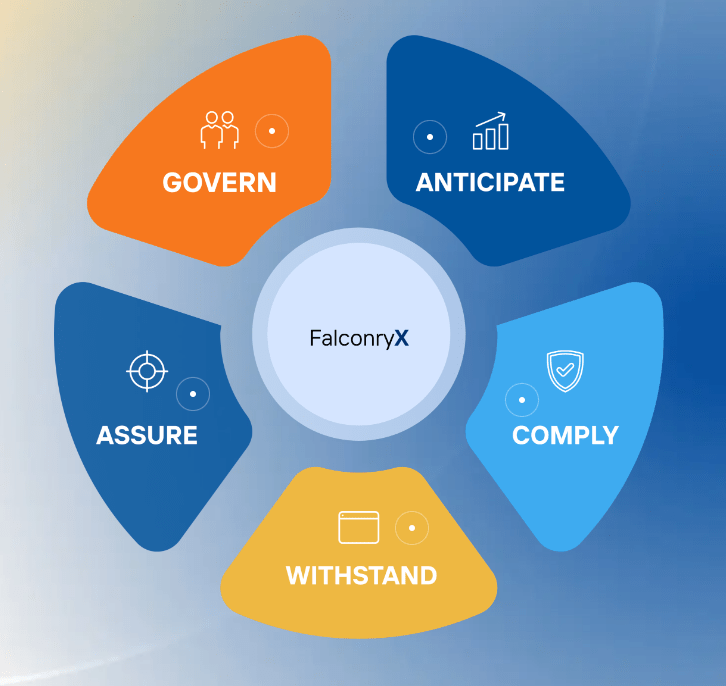
Most organizations did not design their governance environment on a whiteboard. It evolved over time: separate risk tools, standalone compliance trackers, audit systems, and a long tail of spreadsheets and emails. Each function sees its own slice of reality, but nobody sees the whole. Falconry360’s five intelligence layers are meant to fix exactly that—by structuring governance into a single, connected operating model. Instead of thinking in terms of “modules”, Falconry360 organizes governance, risk, compliance, resilience, and assurance into five layers that share the same data model, libraries, and workflows: GOVERN, ANTICIPATE, COMPLY, WITHSTAND, and ASSURE. Together, they turn fragmented activities into one integrated governance operating system. The Logic Behind the Five Layers The five layers are designed around the natural lifecycle of governance: You set direction and guardrails (GOVERN). You identify and understand risks (ANTICIPATE). You translate rules into obligations and actions (COMPLY). You prepare to absorb and survive disruption (WITHSTAND). You validate and strengthen control effectiveness (ASSURE). All of this runs on one shared data model and a set of central libraries: risks, controls, obligations, policies, assets, vendors, issues, and actions. That is what allows information to flow across layers instead of being trapped in separate systems. GOVERN – Strategic Governance Layer GOVERN is where strategy, ethics, culture, and oversight are translated into a structured operating model. It is the layer that connects “tone from the top” with how the organization actually behaves. Typical capabilities in this layer include: Strategy and performance management, aligning objectives and KPIs with risks, controls, and initiatives Policy lifecycle management, including drafting, approvals, publication, and attestations Ethics, integrity, and conduct processes, covering conflicts of interest, disclosures, and breaches Culture and learning management, linking training and awareness to real governance priorities Whistleblowing and case management, so concerns are captured, triaged, and investigated systematically AI governance, defining how AI is used, controlled, and monitored inside the organization For boards and executives, GOVERN provides a clear view of how expectations—on conduct, risk appetite, and AI use—are turned into policies, processes, and real behaviour. ANTICIPATE – Risk & Intelligence Layer ANTICIPATE is the organization’s radar. It provides integrated, near real-time visibility into risks across the enterprise so leadership can see what is coming, not just what has already happened. This layer typically covers: Enterprise risk management and central risk taxonomy Cyber and technology risk, connected to assets, vulnerabilities, and security controls Privacy and data risk, aligned with data protection laws and internal data handling rules Third-party risk management, including due diligence, onboarding, and continuous monitoring Regulatory and external risk intelligence, capturing changes in the environment that affect the risk profile FalconryX, the platform’s AI engine, plays a strong role here by: Suggesting new risks or changes in risk levels based on incidents, external signals, or control data Clustering related risks to avoid duplication and highlight systemic themes Helping prioritize risks based on impact, velocity, and control coverage ANTICIPATE is where you stop treating risk as a static register and start treating it as a living, connected view of exposure. In markets like KSA, the ANTICIPATE layer can be configured directly against NCA and SAMA CSF requirements, so cyber and technology risks are assessed and monitored against those specific control baselines. COMPLY – Regulatory Execution Layer COMPLY translates regulatory complexity into structured, executable workflows. Instead of treating laws and guidelines as documents that sit in shared drives, this layer converts them into obligations that can be owned, evidenced, and reported on. Key elements typically include: Regulatory obligations management and registers for each regulator and jurisdiction Clause-level mapping from regulations, standards, and guidance into internal controls and processes Regulatory change management, from horizon scanning through impact assessment and action tracking Supervisory reporting and exam readiness, with evidence-linked data for faster, cleaner responses Compliance risk assessments and control effectiveness reviews Incident and breach management, including notification workflows and root cause analysis FalconryX helps here by reading and summarising regulatory updates, suggesting clause mappings to existing controls, and drafting first versions of impact analyses or responses. COMPLY is where “what regulators say” becomes “what we need to do” in a structured, auditable way. WITHSTAND – Resilience Layer WITHSTAND is about ensuring the organization can continue to operate—even when critical services, suppliers, or locations are disrupted. It ties operational resilience, business continuity, and crisis management into a single view. Within this layer, organizations can: Identify important business services and map them to processes, systems, locations, people, and third parties Build and maintain business continuity and disaster recovery plans, linked directly to assets and dependencies Run crisis and incident management workflows, including escalation paths, communication plans, and decision logs Conduct crisis simulations and stress tests, capturing learnings and actions Model a Minimum Viable Company (MVC): the essential capabilities that must be preserved to keep the organization functioning during severe disruption Because WITHSTAND uses the same asset inventory, vendor registry, risk data, and control library as the rest of the platform, resilience planning is not a separate world. It reflects the same reality that risk, compliance, and audit teams see. ASSURE – Assurance & Audit Layer ASSURE provides the independent validation layer. It is where internal audit, ICFR, and combined assurance functions test whether controls are designed and operating effectively—and whether risks are truly under control. This layer supports: Risk-based audit planning that leverages live risk, control, and incident data Audit engagements where workpapers, tests, and evidence are linked directly to platform objects (risks, controls, processes, obligations) ICFR programs, including scoping, control testing, and deficiency tracking Issues and remediation management that is shared with risk and compliance, not managed in isolation Continuous monitoring and analytics, where data trends and anomalies can trigger further review Because ASSURE sits on the same data model as the rest of Falconry360, auditors no longer have to rebuild their own view of the world. They test the same risks and controls that management uses, improving trust and reducing duplication. The Power of One Shared Data Model The real strength of the five-layer architecture is not the labels. It is the fact that all layers are connected through shared libraries and
From GRC Tools to a Governance Operating System: Why the Shift Is Inevitable

Most regulated organizations are still running governance on spreadsheets, point solutions, and legacy GRC tools that were never designed for the complexity and speed of today’s risk environment. These setups capture information, but they rarely drive decisions. The result is a governance model that is slow, fragmented, and often out of sync with what boards and regulators expect. A new model is emerging: the governance operating system. Instead of being “a GRC tool” that sits on the side, it becomes the connective layer that runs strategy, risk, compliance, resilience, cyber, and assurance on a single, intelligent platform. Why Legacy GRC Is No Longer Enough Most GRC environments grew organically over years: a risk tool here, a compliance repository there, some audit software, and countless spreadsheets in between. Each does a narrow job, but together they create friction. Data is duplicated, inconsistent, and hard to reconcile. Teams spend more time preparing reports than managing risk, while boards and regulators receive delayed, static snapshots instead of live intelligence. This is not just a technology problem; it is a structural one. The way governance is architected no longer matches how risks emerge, how regulations change, or how fast decisions must be made. Traditional GRC tools were designed in an era when the primary goal was documentation and evidence: Keeping policy registers and tracking acknowledgements Maintaining risk registers and simple risk assessments Recording compliance checks and audit findings They are often module-based and process-centric, with risk, compliance, audit, and IT/security sitting in separate areas with limited integration. Each module may work reasonably well in isolation, but together they create siloed data models, heavy manual reconciliation, and governance that is inherently backward-looking. In short, traditional GRC tools are systems of record; a governance operating system must be a system of execution and intelligence. What a Governance Operating System Is A governance operating system is a connected platform that runs the core disciplines of governance as one integrated fabric, not as separate applications. At its heart is a single data model where risks, controls, obligations, policies, assets, vendors, incidents, issues, and actions all live in one shared structure. The same risk is not recreated in three different systems with three different scores. This model changes how work flows: A regulatory change automatically touches risks, controls, policies, testing, and training, with workflows following that end‑to‑end path rather than departmental boundaries. Dashboards, alerts, and analytics are driven by live data from ongoing activities—control tests, incidents, third‑party assessments, crisis events—not manually compiled slides. Intelligence is embedded into how risks are identified, obligations mapped, controls selected, and reports produced, rather than added later as a cosmetic layer. It represents a shift from recording what governance did to actually running governance as an operating layer of the organization. Why the Shift Is Now Inevitable The move from GRC tools to governance operating systems is being driven by structural pressures that are difficult to ignore. Regulatory complexity and overlap mean organizations now operate under multiple regulators and frameworks at once—central banks, financial services authorities, data protection laws, cyber frameworks, ESG expectations, and sector-specific rules. Mapping all of these into separate tools is not scalable. Risks are deeply interconnected. Cyber, third‑party, privacy, operational resilience, conduct, and financial reporting risks no longer live in neat boxes. A single incident can touch data, vendors, customers, and capital all at once. Fragmented tools cannot reflect these connections. Boards expect a single, clear view of top risks, control effectiveness, resilience posture, and regulatory exposure across entities and jurisdictions, without endless reconciliation. At the same time, risk, compliance, and audit teams cannot grow indefinitely; manual effort must give way to automated data flows, reusable libraries, and AI‑assisted work. When governance remains fragmented, the cost is not just inefficiency. Organizations face missed signals, slower response, and weaker confidence from both leadership and regulators. Design Principles of a Governance Operating System To address these pressures, a governance operating system needs to be designed differently from the ground up. A modern design typically follows a few key principles: Single source of truth Central libraries for risks, controls, obligations, policies, assets, vendors, KPIs, and the audit universe, so everyone works off the same definitions and scoring. End‑to‑end traceability The ability to trace a straight line from strategy and appetite through risks, controls, testing, incidents, issues, remediation, and assurance. Nothing is orphaned and nothing is duplicated. Execution‑first workflows The platform orchestrates tasks, approvals, evidence, and escalations. Dashboards reflect work actually happening in the system, not numbers manually pasted from elsewhere. AI‑native by design Intelligence is used to classify, map, summarise, and prioritise: suggesting risks, mapping regulatory clauses to controls, identifying anomalies in control performance, and drafting first‑cut reports. Human judgment is amplified, not replaced. Progressive adoption Organizations can start with a few high‑value use cases—such as regulatory obligations and enterprise risk—while keeping everything on one fabric so new capabilities plug into the same model rather than creating new silos. How Falconry360 Fits This New Model Falconry360 has been built explicitly as an AI-enabled governance operating system, not as a traditional GRC suite. Its architecture is organised into five integrated intelligence layers: GOVERN – strategy, ethics, culture, policies, and AI governance ANTICIPATE – enterprise, cyber, privacy, and third‑party risk, plus regulatory intelligence COMPLY – regulatory obligations, clause‑level mapping, regulatory change, and reporting WITHSTAND – operational resilience, business continuity, crisis and Minimum Viable Company (MVC) simulations ASSURE – internal audit, ICFR, combined assurance, and continuous monitoring All five layers run on a shared data model and central libraries. FalconryX, the embedded AI engine, sits across them, helping teams identify risks faster, map obligations more accurately, and convert raw data into decision-ready insights. For regulated organizations—especially in banking, financial services, public sector, and critical infrastructure—this means governance is no longer a patchwork of tools. It becomes a single operating layer aligned with regulatory expectations by design. What Changes for Boards and Executives When governance runs on an operating system instead of scattered tools, the impact at the top is tangible. Boards see a unified view of top risks, regulatory obligations, control