
AI Governance in Regulated Environments: Practical Guardrails for CROs, CISOs, and DPOs
As AI becomes embedded in critical business processes and governance platforms, regulated organizations face a dual challenge. They want to use AI to strengthen governance, risk, and compliance—but they must also govern the AI itself to satisfy regulators, boards, and customers. For CROs, CISOs, and DPOs, the question is not whether to use AI, but how to do so safely, transparently, and in line with regulatory expectations. Practical guardrails are essential. The Regulatory Lens on AI Regulators around the world are increasingly clear on a few themes: AI must be explainable enough for firms to understand how key decisions or recommendations are made. Data used to train and run AI models must be lawful, fair, and secure, with appropriate privacy and cyber controls. Accountability cannot be outsourced to models; firms must maintain human oversight and responsibility. High-risk uses of AI (e.g., credit decisions, conduct monitoring, surveillance) must be governed with extra care. AI used within governance platforms is not exempt. If AI helps identify risks, map obligations, or generate reports, firms must be able to show how it works, how it is controlled, and how its outputs are validated. Core Guardrails for AI in Governance CROs, CISOs, and DPOs can work together to put in place a few foundational guardrails. Clear use case inventory and classification Maintain an inventory of AI use cases across the organization, including those embedded in platforms like Falconry360. Classify them by risk (e.g., advisory, decision-support, decision-making) and by impact on customers, markets, and compliance. Defined roles and accountability Assign ownership for AI use cases—typically business owners supported by risk, compliance, and technology. Clarify who approves models, who monitors performance, and who decides when to adjust or retire them. Data governance and privacy controls Ensure training and runtime data respects privacy laws, data residency requirements, and internal classification schemes. Implement access controls and logging for prompts and outputs where sensitive data may be handled. Model explainability and documentation Require documentation of model purpose, inputs, outputs, limitations, and known failure modes. For critical use cases, ensure that AI decisions or recommendations can be explained in business terms. Human-in-the-loop for material decisions Keep humans in control where AI influences high-impact decisions (e.g., regulatory responses, risk ratings, major control changes). Define when human review is mandatory and how overrides are recorded. Monitoring, validation, and periodic review Track performance, bias, and error patterns. Schedule regular reviews of AI behaviour, particularly after regulatory changes, major incidents, or shifts in data. These guardrails turn AI governance from an abstract principle into a concrete set of practices. Falconry360 as a Platform for AI Governance Because Falconry360 already manages policies, risks, controls, incidents, and assurance activities, it is a natural place to operationalise AI governance: AI-related policies and standards can be created and maintained in the GOVERN layer. AI risks can be captured in the risk taxonomy and linked to controls in ANTICIPATE. AI-related regulatory requirements can be tracked in COMPLY, mapped to obligations and internal standards. Resilience scenarios in WITHSTAND can include failures or misuse of AI components. ASSURE can include AI-related audits, model reviews, and control testing, with findings and actions tracked like any other assurance work. FalconryX itself can be brought under this governance, with its use cases documented, monitored, and reviewed like any other critical capability. Practical Steps for CROs, CISOs, and DPOs To make AI governance real, leaders can: Establish an AI governance working group that includes risk, compliance, security, data, legal, and business stakeholders. Use the existing governance operating model (committees, policies, risk appetite, controls) as the structure for AI oversight—instead of creating a parallel regime. Prioritise governance for AI use cases that are high-impact or close to regulatory scrutiny (e.g., financial decisions, surveillance, customer outcomes, regulatory reporting). Ensure that board and senior management are briefed regularly on AI use, benefits, and risks—supported by structured reporting from platforms like Falconry360. Done well, AI governance becomes a natural extension of existing governance—not an isolated, theoretical exercise. It gives regulators, customers, and boards confidence that AI is being used responsibly and effectively to strengthen, not weaken, the control environment.
How AI Transforms Risk Identification, Control Mapping, and Regulatory Alignment

Risk, control, and regulatory alignment have traditionally been human-intensive, document-heavy activities. Teams read policies and circulars, run workshops, map controls manually, and update spreadsheets when something changes. It works—up to a point—but it is slow, hard to scale, and prone to inconsistency. AI, when embedded into a platform like Falconry360 through FalconryX, fundamentally changes how these activities are carried out. It doesn’t replace expert judgment, but it does transform the speed, consistency, and depth with which risks are identified, controls are mapped, and regulatory expectations are operationalised. AI in Risk Identification: From Static Registers to Living Maps Traditional risk identification relies on periodic workshops, interviews, and static risk registers. These tend to age quickly and may miss emerging signals. With AI in the loop: New data drives ongoing risk discovery Incidents, near misses, audit findings, customer complaints, and external events can all be analysed for patterns. FalconryX can suggest new risks or changes to existing risk ratings when it detects recurring themes or unusual trends. Clustering and similarity analysis Related risks can be grouped automatically, highlighting systemic issues rather than isolated entries. Duplicates and overlaps can be identified and merged, keeping the risk universe cleaner and more manageable. Contextual enrichment AI can link risks to relevant regulations, business services, assets, third parties, and controls. This transforms a simple risk description into a richer risk object, with clear context and impact surface. The result is a living risk map that updates as the organization’s activities and environment change, instead of a static list that is revised a few times a year. AI in Control Mapping: Smarter Coverage, Less Manual Work Control mapping is one of the most repetitive and error-prone aspects of governance. Teams must understand regulations, frameworks, and internal requirements, then decide which controls address which obligations. FalconryX can help in several ways: Reading and interpreting regulatory and framework text AI can parse regulatory documents, standards, and guidelines to extract obligations and key requirements. It can classify clauses by topic (e.g., governance, risk management, disclosure, data protection, operational resilience). Suggesting control mappings Based on clause content and the existing control library, FalconryX can propose which controls are likely to address specific obligations. It can highlight probable mapping gaps, where no controls appear to cover a requirement. Reusing knowledge across frameworks Once a set of controls is mapped to one framework, AI can use that pattern to suggest mappings for similar requirements in other frameworks or regulators. This helps build and maintain crosswalks between, for example, multiple central bank guidelines and international standards. Humans still decide whether mappings are correct, but AI dramatically reduces the time and effort needed to get to a high-quality first draft. AI in Regulatory Alignment: From Documents to Executable Obligations Regulatory alignment often breaks down at the point where interpretation must turn into action. Laws and circulars are read, summarised, and discussed, but translating them into structured obligations, tasks, controls, and evidence can be slow. With FalconryX embedded in the COMPLY layer: Regulatory text becomes structured data AI can convert unstructured documents into obligations with attributes (e.g., business line, topic, timeline, affected processes). These obligations can be directly linked to owners, controls, and evidence within the platform. Impact analysis is accelerated When a regulation changes, AI can highlight which existing obligations, controls, policies, and risk assessments may be affected. This helps teams focus quickly on the areas where alignment might be at risk. Reporting and responses are more consistent AI can draft responses to recurring regulatory requests using live data, ensuring that answers are consistent with the platform’s single source of truth. It can also propose structure and content for thematic reports or self-assessments. Regulatory alignment becomes less about manually copy‑pasting into documents and more about keeping a live, traceable link between what the regulator expects and what the organization does. Combining the Three: A Connected AI-Enhanced Cycle The real power appears when AI-enhanced risk identification, control mapping, and regulatory alignment are connected: New regulatory requirements flow into the obligations register as structured items. FalconryX suggests control mappings and highlights gaps. Where gaps exist, new controls are designed and linked to risks, services, and third parties. Incidents and test results feed back into risk ratings and control effectiveness. Changes in patterns trigger re‑assessments of both risk and regulatory alignment. This creates a continuous, AI‑assisted loop where risk, control, and regulation stay aligned far more dynamically than manual processes allow.
From Copilot to Autonomous Intelligence: The Three Phases of FalconryX

AI in governance often arrives as a feature: a chatbot, a summariser, or a smart search bar. Helpful, yes—but not transformative. FalconryX is designed differently. It is built to take organizations on a maturity journey, from basic assistance to continuous, intelligence-driven governance, without sacrificing control or trust. That journey moves through three practical phases: Copilot, Assisted Automation, and Autonomous Intelligence. Each phase builds on the last, so you can adopt AI at a pace that matches your risk appetite, data quality, and regulatory expectations. Phase 1 – Copilot: Better Understanding, Faster In the first phase, FalconryX acts as a copilot that helps people do what they already do—only faster and with more clarity. Common use cases in this phase include: Natural-language Q&A on platform data “What are our top risks for retail banking?” “Which controls are linked to this regulation?” “Show incidents related to third-party outages in the last 12 months.” Summarisation and synthesis Condensing long policies, exam reports, risk assessments, and audit findings into concise, role-specific summaries. Highlighting key changes between document versions. Smart navigation and clustering Grouping similar risks, incidents, and issues to reduce duplication. Helping teams see patterns that might otherwise sit hidden across multiple records. The value here is immediate: less time spent searching, reading, and reconciling; more time spent thinking and deciding. Crucially, decisions and workflows do not change—teams simply work with clearer, richer information. Phase 2 – Assisted Automation: AI Inside the Workflow The second phase is where FalconryX moves from “answering questions” to helping perform structured work. AI becomes part of the process itself. Typical examples include: Risk and control suggestions Proposing relevant risks when a new product, process, or third party is created. Suggesting candidate controls for a new or changed process based on similar patterns elsewhere in the organization. Regulatory and framework mapping Reading regulatory updates or standards and suggesting clause-level mappings to existing obligations and controls. Highlighting potential gaps where no control currently covers a new requirement. Drafting and documentation Generating first drafts of reports, management updates, or responses to supervisory requests, using live platform data as input. Drafting policy sections or guidance based on specified frameworks and risk appetites. Recommendation of actions Suggesting remedial actions where repeated incidents point to control weaknesses. Proposing follow-up assessments or tests when certain thresholds are breached. In this phase, humans remain firmly in the driver’s seat: they review, edit, accept, or reject AI suggestions. FalconryX reduces manual effort and brings consistency, but accountability and judgment stay with the governance, risk, compliance, and audit teams. Phase 3 – Autonomous Intelligence: Continuous Signals and Insights The third phase is about making governance continuous and proactive. FalconryX begins to monitor, interpret, and propose actions in near real time, acting as an always-on intelligence layer. Key capabilities in this phase can include: Regulatory change detection and impact flags Monitoring regulatory sources and flagging changes that might affect existing obligations, controls, or policies. Suggesting where mappings and implementations may need to be reviewed. Risk drift and control performance monitoring Watching trends in incidents, test results, metrics, and external signals for signs that risk exposure is increasing or controls are weakening. Triggering alerts when patterns indicate emerging risk clusters or deteriorating control effectiveness. Automated alerts and proposals Proactively recommending scenario tests, resilience exercises, or targeted audits based on observed patterns. Suggesting re-prioritisation of risk registers or audit plans when reality diverges from assumptions. Dynamic executive reporting Regularly generating updated executive and board-level narratives that draw from live risk, compliance, resilience, and assurance data. Keeping leadership informed with minimal manual assembly. Even here, “autonomous” does not mean uncontrolled. FalconryX surfaces insights and suggested actions, but human leaders decide what to do. The difference is that governance shifts from reactive reporting to real-time, insight-driven steering. Moving Through the Phases Safely No organization needs to jump straight to Phase 3. A pragmatic path often looks like this: Start with FalconryX as a copilot for search, Q&A, and summarisation. Introduce assisted automation for specific, well-understood workflows (risk suggestions, clause mapping, report drafting). Add continuous monitoring, alerts, and recommendations where data quality is strong and oversight processes are defined. By designing FalconryX around these three phases, Falconry360 allows you to adopt AI in governance in a controlled, transparent, and value-driven way—growing from assistance to automation to genuine autonomous intelligence, without losing sight of accountability.
What Is an AI-Native GRC Platform? Introducing FalconryX

AI is rapidly entering the governance, risk, and compliance space—but in many organizations, it appears as a thin layer on top of old ways of working. A chatbot is added to answer basic questions. A summarisation tool is used to turn long reports into short ones. An analytics module sits off to the side, crunching exports from core systems. All of this can be useful, but it doesn’t fundamentally change governance. Data is still fragmented, workflows are still manual, and governance is still largely about reporting after the fact. The organization gets AI-enabled tasks, not AI-enabled governance. An AI-native GRC platform starts from a different place. It assumes that intelligence is part of the core fabric—how data is structured, how workflows run, how decisions are supported—not something bolted on later. FalconryX is built on exactly that assumption. What “AI-Native” Really Means in GRC Being AI-native is not about having a chatbot or a few smart features. It’s about how the platform is architected. An AI-native GRC platform: Uses a single, structured data model across governance, risk, compliance, resilience, and assurance, so AI has complete and consistent context. Embeds AI into core workflows—risk assessments, obligation mapping, incident handling, audit planning—rather than treating it as a separate, optional tool. Treats natural-language interaction as a first-class way to navigate and query the environment. Is designed so that AI outputs (suggestions, mappings, summaries, alerts) are traceable, reviewable, and governed, not opaque and unaccountable. In other words, AI is not a feature; it is part of how the platform thinks and operates. FalconryX: The Intelligence Engine Inside Falconry360 FalconryX is Falconry360’s embedded AI intelligence engine. It sits across the governance operating system—spanning the five intelligence layers (GOVERN, ANTICIPATE, COMPLY, WITHSTAND, ASSURE)—and works directly on the shared data model. Instead of being a separate application, FalconryX: Reads and understands risks, controls, obligations, policies, assets, vendors, incidents, and issues in their real relationships. Supports users inside the workflows they already run, making suggestions and generating outputs in context. Learns over time from the organization’s own taxonomies, decisions, and mappings, so it becomes more tailored and effective. This is the difference between “AI in the corner” and “AI in the core.” The Three Phases of FalconryX Adoption To make AI practical and safe in governance, FalconryX is designed to support a gradual maturity journey. You don’t jump straight to full autonomy; you move through three clear phases. Phase 1 – Copilot for Understanding In the first phase, FalconryX acts as a copilot that makes information easier to find and understand: Answering natural-language questions like “What are our top risks for retail lending?” or “Show me controls mapped to this regulation.” Summarising long documents—policies, frameworks, exam reports, incidents—into concise, role-specific views. Grouping or clustering similar risks, issues, or incidents to reduce duplication and bring patterns into focus. Here, governance teams still perform the same tasks as before, but faster and with more clarity. Phase 2 – Assisted Automation of Workflows In the second phase, FalconryX starts doing real work inside governance processes, with users in control: Suggesting risks when a new product, service, or third party is created. Proposing control mappings for new regulatory clauses or updated frameworks. Drafting first versions of management reports, regulatory responses, or board summaries. Recommending remedial actions based on recurring incidents or control failures. People remain the decision-makers, but the manual heavy lifting (reading, mapping, drafting, basic analysis) is dramatically reduced. Phase 3 – Autonomous Intelligence and Continuous Signals In the third phase, FalconryX helps create continuous governance loops: Monitoring for regulatory changes and highlighting where obligations and mappings might be impacted. Watching trends in controls, incidents, and assessments to detect risk drift or early signs of stress. Triggering alerts and recommended actions when certain thresholds or patterns are observed. Generating recurring executive and board-level summaries from live data, with minimal manual assembly. Even at this stage, autonomy does not mean “no humans.” It means the system proactively surfaces what matters and proposes responses; leadership chooses and approves. What FalconryX Does Across the Governance Lifecycle Because FalconryX operates on the unified Falconry360 data model, its intelligence can be reused across multiple governance domains. AI-Assisted Risk Identification and Prioritisation Identify new or emerging risks by analysing incidents, assessment results, third-party data, and external signals. Suggest risk ratings and priorities based on impact, likelihood, velocity, and control coverage. Highlight clusters of related risks that may indicate systemic issues rather than isolated items. Intelligent Control and Regulatory Mapping Read regulatory changes and guidance, and propose relevant obligations and clauses. Map those obligations to existing controls, indicating where coverage exists and where gaps may require new or enhanced controls. Help maintain living crosswalks between frameworks (e.g., between multiple regulators and standards) using the same underlying mappings. Automated Policy and Compliance Support Generate first drafts of policies or policy updates aligned with specific regulations or internal standards. Draft structured responses for recurring regulatory submissions, inspections, or exam queries based on live platform evidence. Support compliance monitoring by flagging areas where controls or behavior appear inconsistent with defined obligations. Predictive and Forward-Looking Analytics Analyse trends in incident data, test results, issues, and third-party assessments to flag emerging hotspots. Suggest where additional testing, scenario analysis, or resilience planning may be warranted. Provide early warnings when risk levels start drifting away from defined appetite. Executive Insight Generation Build tailored, narrative views for different audiences: boards, executive committees, regulators, and auditors. Automatically assemble risk, compliance, resilience, and assurance data into a coherent story, reducing manual slide-building. Support ad hoc questions during discussions through natural-language querying of live data. FalconryX Inside the Five Intelligence Layers Because FalconryX is integrated into Falconry360’s five layers, its impact is felt across the entire governance operating system. In GOVERN, it helps summarise and compare policies, highlight inconsistencies, and surface themes for culture, training, and AI governance. In ANTICIPATE, it clusters risks, interprets incident patterns, and supports scenario thinking with data-backed insights. In COMPLY, it reads regulations and circulars, proposes clause mappings, and drafts impact assessments and responses. In WITHSTAND, it suggests resilience scenarios, tests assumptions about Minimum Viable Company, and
Designing a Single Data Model for Risk, Compliance, Resilience, and Assurance

Most governance environments don’t fail because teams lack effort or expertise. They fail because everyone is working from a different version of reality. Risk has its registers, compliance has its obligation trackers, resilience has its plans, and audit has its workpapers—often with overlapping but inconsistent data. A single data model is about fixing that foundation so every governance function sees, and works from, the same truth. For platforms like Falconry360, that single model is not a technical luxury; it is the core architectural choice that allows governance, risk, compliance, resilience, and assurance to operate as one system instead of a set of disconnected activities. Why Multiple Data Models Create Governance Friction When each function maintains its own data model, several problems appear quickly: The same risk is described and scored differently across teams. Controls are duplicated or named differently, making coverage hard to assess. Regulatory obligations are captured in documents and spreadsheets, then manually mapped into tools. Incidents and issues are logged in separate systems, breaking the chain from cause to remediation. This fragmentation makes simple questions hard to answer: which controls cover this obligation, which risks are tied to this product or service, which incidents reveal a systemic weakness, or how many open issues relate to a specific regulator? The result is governance that is slow, expensive, and often reactive. What a Single Data Model Looks Like A single data model does not mean one giant table. It means a shared set of entities and relationships that every governance function agrees on and uses. At a minimum, this usually includes: Risks – with common taxonomy, categories, and attributes (e.g., impact, likelihood, owners, appetite linkage). Controls – design and operating details, mapped to risks, obligations, processes, and assets. Regulatory obligations and frameworks – clauses, articles, sections, and control requirements from laws, regulations, and standards. Policies and procedures – governance documents linked to the risks and obligations they address. Assets and processes – applications, infrastructure, data, business services, and process maps. Third parties – vendors and partners, with their risk profiles and dependencies. Incidents, events, and issues – a common structure to log events, root causes, impacts, and actions. Actions and remediation plans – tasks, owners, deadlines, and status. Each of these has a defined schema, but the real power lies in the relationships between them. Key Relationships That Make the Model Work The value of the data model is not just in what it stores, but how it connects. Some of the most important relationships include: Risk ↔ Control Which controls mitigate which risks, and how effective are they? Control ↔ Obligation / Framework requirement Which controls provide evidence against specific regulatory clauses or standard requirements? Process / Asset / Service ↔ Risk / Control Which business services and systems are exposed to which risks, and which controls protect them? Third Party ↔ Service / Asset / Risk Which vendors support critical processes and services, and what risks arise from them? Incident ↔ Risk / Control / Process / Obligation Which risks materialised, which controls failed or were absent, and what obligations might have been breached? Issue / Action ↔ Risk / Control / Obligation / Audit Finding What remediation work is being done, why, and how does it change the risk or compliance picture? When these linkages are built into the model rather than added in spreadsheets, they become available to every function and every layer of governance. How Each Discipline Uses the Same Model Differently A single data model does not mean everyone sees the same screens. It means everyone works from the same underlying reality, but through their own lens. Risk (ANTICIPATE) Views risks, scenarios, and indicators across the business, with direct visibility into linked controls, incidents, and third‑party dependencies. Compliance (COMPLY) Starts from obligations and frameworks, but immediately sees the controls, policies, and evidence mapped to each clause, and the incidents or issues that might affect compliance. Resilience (WITHSTAND) Designs impact tolerances and recovery strategies based on services, assets, and third parties linked to specific risks and controls, rather than maintaining a separate world of continuity data. Assurance and Audit (ASSURE) Plans and executes audits using the same risks, controls, obligations, and incidents that management teams rely on, and then feeds test results and findings back into the same model. Strategic Governance (GOVERN) Aligns strategy, appetite, policies, ethics, and AI governance with the actual risk, control, and incident landscape captured in the platform. Because they share the model, changes made in one area (for example, adding a new control, updating an obligation mapping, or closing a major issue) are immediately relevant to the others. Practical Design Principles for a Single Data Model Designing this kind of model is as much about governance as about technology. A few principles help keep it robust and usable: Common taxonomies and naming standards Agree on how risks, controls, processes, and obligations are classified and named so they can be reused and searched easily. Reusability over duplication Use libraries for risks, controls, and obligations that can be reused across entities, jurisdictions, and business units, rather than copying and modifying locally. Minimal but meaningful attributes Capture enough metadata (owners, impact, likelihood, status, geography, business unit, regulator, etc.) to filter and report effectively, but avoid over‑engineering fields that nobody will maintain. Strong ownership Assign clear ownership for each library and for key relationships (for example, who owns the risk taxonomy, who approves new controls, who validates obligation mappings). Change management and versioning Track changes to the model over time so that you can explain, to internal audit or regulators, how definitions and mappings have evolved. With these principles in place, the model remains a living asset rather than a static diagram. How Falconry360 Implements the Single Data Model Falconry360 is architected around exactly this kind of shared data model. Its central libraries—for risks, controls, regulatory frameworks, obligations, assets, vendors, policies, KPIs, and audit universe—are used across all five intelligence layers: GOVERN, ANTICIPATE, COMPLY, WITHSTAND, and ASSURE. When a new regulatory requirement is added in COMPLY, it is mapped
Governance as a Performance Enabler: Moving from Reporting to Decision Intelligence

For many organizations, “governance” still means producing reports: risk heatmaps, compliance dashboards, audit summaries, and resilience status updates. These artifacts are important, but they often arrive late, live in PowerPoint, and are disconnected from day‑to‑day decisions. Governance becomes a periodic ritual instead of a real‑time enabler of performance. The real opportunity is to treat governance not as a reporting function, but as a decision system. In that model, governance provides leaders with timely, reliable, and connected intelligence so they can take better risks, move faster, and respond confidently to regulators, customers, and crises. The Limits of Governance-as-Reporting Most governance functions were built around the need to demonstrate compliance and control. As a result, they are optimised for documentation rather than decisions. Typical symptoms include: Governance teams spending weeks assembling board and committee packs from multiple tools and spreadsheets Risk, compliance, audit, and cyber each producing their own dashboards, with different taxonomies and ratings Key decisions being made on static snapshots that are already out of date by the time they are presented In this world, governance is perceived as a cost centre and a brake on speed. It satisfies formal requirements, but it struggles to influence real business choices—such as launching products, entering markets, or changing operating models. What Decision Intelligence in Governance Looks Like Decision intelligence in governance means that information is structured, connected, and available in a way that directly supports choices leaders must make. Instead of asking, “What can we report?”, the system is designed to answer questions like: “If we launch this product or enter this market, what risks, obligations, and control gaps matter most?” “Where are we taking risks that are misaligned with our stated appetite or regulatory expectations?” “Which incidents and control failures are early signals of a bigger issue in a particular business line or region?” “What trade‑offs are we making under stress, and how do they affect our Minimum Viable Company?” To enable this, data from risk, compliance, resilience, cyber, and audit needs to live in a unified model, with clear linkages between strategy, risks, controls, obligations, incidents, and assurance outcomes. When those connections are in place, governance insights become inherently decision‑shaped rather than report‑shaped. How Governance Becomes a Performance Enabler When governance data and workflows are integrated, several shifts happen that directly support performance. From backward‑looking to forward‑looking Instead of only explaining what went wrong, governance surfaces emerging themes, risk drift, and regulatory signals early enough to adjust course. Leadership can make informed decisions before an issue becomes a loss or a breach. From one‑size‑fits‑all to context‑specific insights A single central view can be sliced by business unit, product, region, or regulator. This allows leaders to see exactly what matters for their portfolio and to compare units on risk‑adjusted performance rather than just raw volume. From friction to flow in execution When obligations, risks, and controls are linked to workflows and owners, decisions taken at the top can be translated into concrete actions, tracked to completion, and evidenced. This reduces execution risk and accelerates change. From risk avoidance to informed risk‑taking With clearer visibility of exposures and mitigations, leadership can say “yes” more often, but with conditions: proceed, provided certain controls are in place, certain thresholds are monitored, and certain scenarios are tested. In this mode, governance does not slow the business down; it gives the business a sharper edge. The Role of AI and Real‑Time Data AI and real‑time data are critical enablers of this shift from reporting to decision intelligence. AI makes sense of complexity It can help classify and cluster risks, interpret regulatory changes, suggest control mappings, and highlight patterns across incidents and assessments. This reduces noise and brings the most relevant information to the surface. Real‑time data keeps the picture current When control tests, incidents, assessments, and third‑party reviews feed into a common platform continuously, dashboards and alerts are always close to the real state of the environment. Decisions are based on living data, not last quarter’s snapshot. Narratives and recommendations become dynamic Instead of manually assembling lengthy reports, AI can draft concise, tailored narratives for different audiences—executive committees, boards, regulators—grounded in the same underlying data. Together, this turns governance from a static documentation engine into a dynamic advisory layer for the business. How Falconry360 and FalconryX Support Decision Intelligence Falconry360 is designed as a governance operating system with a single data model across its five intelligence layers: GOVERN, ANTICIPATE, COMPLY, WITHSTAND, and ASSURE. That structure is what allows decision intelligence to emerge. Strategy, policies, and AI governance in GOVERN are linked to the risks and obligations that shape them. Enterprise, cyber, privacy, and third‑party risks in ANTICIPATE are connected to controls, incidents, and business services. Regulatory obligations and changes in COMPLY map directly into actions, owners, and evidence. Resilience scenarios and MVC assumptions in WITHSTAND draw on the same assets, vendors, and risks. Assurance activities in ASSURE test the same controls and processes that management relies on. FalconryX, the embedded AI engine, then uses this connected data to provide intelligent assistance: suggesting risks, mapping regulations, spotting patterns, and drafting reports and executive summaries. Leaders can ask natural‑language questions and get answers grounded in live platform data. The result is a governance environment where: Board packs are generated from connected, always‑current data. Risk and compliance discussions focus on choices and trade‑offs, not on reconciling numbers. Regulatory interactions are supported by clear, evidence‑linked narratives. Performance conversations naturally incorporate risk, resilience, and assurance perspectives. Making the Shift in Practice Moving from governance‑as‑reporting to governance‑as‑decision‑intelligence does not require a big bang. A pragmatic approach is to: Start by centralising key libraries—risks, controls, obligations, assets, vendors—and linking them to incidents and issues. Identify a few critical decision forums (for example, product approval, investment committees, or risk committees) and design views tailored to the questions they regularly face. Introduce AI gradually to accelerate tasks that are already well understood: mapping, summarising, prioritising, and drafting. Use feedback from leadership to refine which insights are most useful, and iterate. Over time, the organization experiences governance differently. Instead of
Inside Falconry360’s Five Intelligence Layers: GOVERN, ANTICIPATE, COMPLY, WITHSTAND, ASSURE
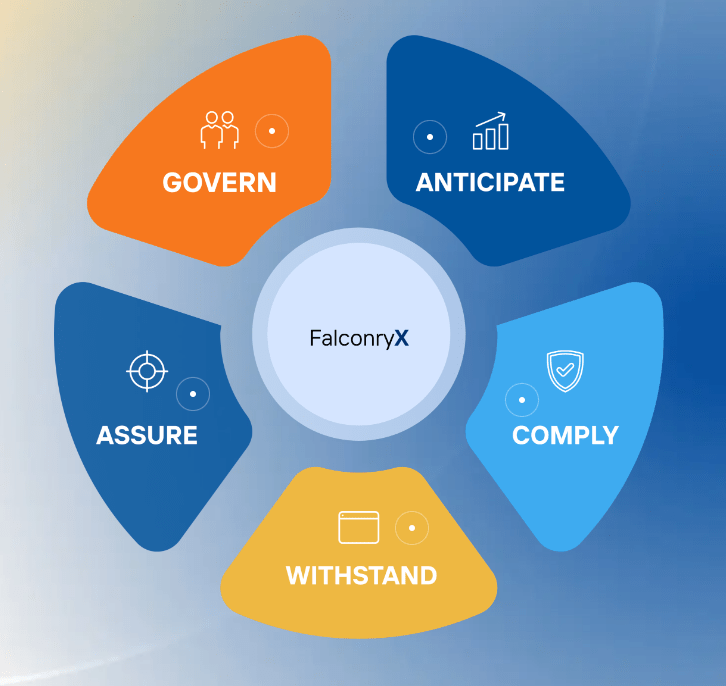
Most organizations did not design their governance environment on a whiteboard. It evolved over time: separate risk tools, standalone compliance trackers, audit systems, and a long tail of spreadsheets and emails. Each function sees its own slice of reality, but nobody sees the whole. Falconry360’s five intelligence layers are meant to fix exactly that—by structuring governance into a single, connected operating model. Instead of thinking in terms of “modules”, Falconry360 organizes governance, risk, compliance, resilience, and assurance into five layers that share the same data model, libraries, and workflows: GOVERN, ANTICIPATE, COMPLY, WITHSTAND, and ASSURE. Together, they turn fragmented activities into one integrated governance operating system. The Logic Behind the Five Layers The five layers are designed around the natural lifecycle of governance: You set direction and guardrails (GOVERN). You identify and understand risks (ANTICIPATE). You translate rules into obligations and actions (COMPLY). You prepare to absorb and survive disruption (WITHSTAND). You validate and strengthen control effectiveness (ASSURE). All of this runs on one shared data model and a set of central libraries: risks, controls, obligations, policies, assets, vendors, issues, and actions. That is what allows information to flow across layers instead of being trapped in separate systems. GOVERN – Strategic Governance Layer GOVERN is where strategy, ethics, culture, and oversight are translated into a structured operating model. It is the layer that connects “tone from the top” with how the organization actually behaves. Typical capabilities in this layer include: Strategy and performance management, aligning objectives and KPIs with risks, controls, and initiatives Policy lifecycle management, including drafting, approvals, publication, and attestations Ethics, integrity, and conduct processes, covering conflicts of interest, disclosures, and breaches Culture and learning management, linking training and awareness to real governance priorities Whistleblowing and case management, so concerns are captured, triaged, and investigated systematically AI governance, defining how AI is used, controlled, and monitored inside the organization For boards and executives, GOVERN provides a clear view of how expectations—on conduct, risk appetite, and AI use—are turned into policies, processes, and real behaviour. ANTICIPATE – Risk & Intelligence Layer ANTICIPATE is the organization’s radar. It provides integrated, near real-time visibility into risks across the enterprise so leadership can see what is coming, not just what has already happened. This layer typically covers: Enterprise risk management and central risk taxonomy Cyber and technology risk, connected to assets, vulnerabilities, and security controls Privacy and data risk, aligned with data protection laws and internal data handling rules Third-party risk management, including due diligence, onboarding, and continuous monitoring Regulatory and external risk intelligence, capturing changes in the environment that affect the risk profile FalconryX, the platform’s AI engine, plays a strong role here by: Suggesting new risks or changes in risk levels based on incidents, external signals, or control data Clustering related risks to avoid duplication and highlight systemic themes Helping prioritize risks based on impact, velocity, and control coverage ANTICIPATE is where you stop treating risk as a static register and start treating it as a living, connected view of exposure. In markets like KSA, the ANTICIPATE layer can be configured directly against NCA and SAMA CSF requirements, so cyber and technology risks are assessed and monitored against those specific control baselines. COMPLY – Regulatory Execution Layer COMPLY translates regulatory complexity into structured, executable workflows. Instead of treating laws and guidelines as documents that sit in shared drives, this layer converts them into obligations that can be owned, evidenced, and reported on. Key elements typically include: Regulatory obligations management and registers for each regulator and jurisdiction Clause-level mapping from regulations, standards, and guidance into internal controls and processes Regulatory change management, from horizon scanning through impact assessment and action tracking Supervisory reporting and exam readiness, with evidence-linked data for faster, cleaner responses Compliance risk assessments and control effectiveness reviews Incident and breach management, including notification workflows and root cause analysis FalconryX helps here by reading and summarising regulatory updates, suggesting clause mappings to existing controls, and drafting first versions of impact analyses or responses. COMPLY is where “what regulators say” becomes “what we need to do” in a structured, auditable way. WITHSTAND – Resilience Layer WITHSTAND is about ensuring the organization can continue to operate—even when critical services, suppliers, or locations are disrupted. It ties operational resilience, business continuity, and crisis management into a single view. Within this layer, organizations can: Identify important business services and map them to processes, systems, locations, people, and third parties Build and maintain business continuity and disaster recovery plans, linked directly to assets and dependencies Run crisis and incident management workflows, including escalation paths, communication plans, and decision logs Conduct crisis simulations and stress tests, capturing learnings and actions Model a Minimum Viable Company (MVC): the essential capabilities that must be preserved to keep the organization functioning during severe disruption Because WITHSTAND uses the same asset inventory, vendor registry, risk data, and control library as the rest of the platform, resilience planning is not a separate world. It reflects the same reality that risk, compliance, and audit teams see. ASSURE – Assurance & Audit Layer ASSURE provides the independent validation layer. It is where internal audit, ICFR, and combined assurance functions test whether controls are designed and operating effectively—and whether risks are truly under control. This layer supports: Risk-based audit planning that leverages live risk, control, and incident data Audit engagements where workpapers, tests, and evidence are linked directly to platform objects (risks, controls, processes, obligations) ICFR programs, including scoping, control testing, and deficiency tracking Issues and remediation management that is shared with risk and compliance, not managed in isolation Continuous monitoring and analytics, where data trends and anomalies can trigger further review Because ASSURE sits on the same data model as the rest of Falconry360, auditors no longer have to rebuild their own view of the world. They test the same risks and controls that management uses, improving trust and reducing duplication. The Power of One Shared Data Model The real strength of the five-layer architecture is not the labels. It is the fact that all layers are connected through shared libraries and
From GRC Tools to a Governance Operating System: Why the Shift Is Inevitable

Most regulated organizations are still running governance on spreadsheets, point solutions, and legacy GRC tools that were never designed for the complexity and speed of today’s risk environment. These setups capture information, but they rarely drive decisions. The result is a governance model that is slow, fragmented, and often out of sync with what boards and regulators expect. A new model is emerging: the governance operating system. Instead of being “a GRC tool” that sits on the side, it becomes the connective layer that runs strategy, risk, compliance, resilience, cyber, and assurance on a single, intelligent platform. Why Legacy GRC Is No Longer Enough Most GRC environments grew organically over years: a risk tool here, a compliance repository there, some audit software, and countless spreadsheets in between. Each does a narrow job, but together they create friction. Data is duplicated, inconsistent, and hard to reconcile. Teams spend more time preparing reports than managing risk, while boards and regulators receive delayed, static snapshots instead of live intelligence. This is not just a technology problem; it is a structural one. The way governance is architected no longer matches how risks emerge, how regulations change, or how fast decisions must be made. Traditional GRC tools were designed in an era when the primary goal was documentation and evidence: Keeping policy registers and tracking acknowledgements Maintaining risk registers and simple risk assessments Recording compliance checks and audit findings They are often module-based and process-centric, with risk, compliance, audit, and IT/security sitting in separate areas with limited integration. Each module may work reasonably well in isolation, but together they create siloed data models, heavy manual reconciliation, and governance that is inherently backward-looking. In short, traditional GRC tools are systems of record; a governance operating system must be a system of execution and intelligence. What a Governance Operating System Is A governance operating system is a connected platform that runs the core disciplines of governance as one integrated fabric, not as separate applications. At its heart is a single data model where risks, controls, obligations, policies, assets, vendors, incidents, issues, and actions all live in one shared structure. The same risk is not recreated in three different systems with three different scores. This model changes how work flows: A regulatory change automatically touches risks, controls, policies, testing, and training, with workflows following that end‑to‑end path rather than departmental boundaries. Dashboards, alerts, and analytics are driven by live data from ongoing activities—control tests, incidents, third‑party assessments, crisis events—not manually compiled slides. Intelligence is embedded into how risks are identified, obligations mapped, controls selected, and reports produced, rather than added later as a cosmetic layer. It represents a shift from recording what governance did to actually running governance as an operating layer of the organization. Why the Shift Is Now Inevitable The move from GRC tools to governance operating systems is being driven by structural pressures that are difficult to ignore. Regulatory complexity and overlap mean organizations now operate under multiple regulators and frameworks at once—central banks, financial services authorities, data protection laws, cyber frameworks, ESG expectations, and sector-specific rules. Mapping all of these into separate tools is not scalable. Risks are deeply interconnected. Cyber, third‑party, privacy, operational resilience, conduct, and financial reporting risks no longer live in neat boxes. A single incident can touch data, vendors, customers, and capital all at once. Fragmented tools cannot reflect these connections. Boards expect a single, clear view of top risks, control effectiveness, resilience posture, and regulatory exposure across entities and jurisdictions, without endless reconciliation. At the same time, risk, compliance, and audit teams cannot grow indefinitely; manual effort must give way to automated data flows, reusable libraries, and AI‑assisted work. When governance remains fragmented, the cost is not just inefficiency. Organizations face missed signals, slower response, and weaker confidence from both leadership and regulators. Design Principles of a Governance Operating System To address these pressures, a governance operating system needs to be designed differently from the ground up. A modern design typically follows a few key principles: Single source of truth Central libraries for risks, controls, obligations, policies, assets, vendors, KPIs, and the audit universe, so everyone works off the same definitions and scoring. End‑to‑end traceability The ability to trace a straight line from strategy and appetite through risks, controls, testing, incidents, issues, remediation, and assurance. Nothing is orphaned and nothing is duplicated. Execution‑first workflows The platform orchestrates tasks, approvals, evidence, and escalations. Dashboards reflect work actually happening in the system, not numbers manually pasted from elsewhere. AI‑native by design Intelligence is used to classify, map, summarise, and prioritise: suggesting risks, mapping regulatory clauses to controls, identifying anomalies in control performance, and drafting first‑cut reports. Human judgment is amplified, not replaced. Progressive adoption Organizations can start with a few high‑value use cases—such as regulatory obligations and enterprise risk—while keeping everything on one fabric so new capabilities plug into the same model rather than creating new silos. How Falconry360 Fits This New Model Falconry360 has been built explicitly as an AI-enabled governance operating system, not as a traditional GRC suite. Its architecture is organised into five integrated intelligence layers: GOVERN – strategy, ethics, culture, policies, and AI governance ANTICIPATE – enterprise, cyber, privacy, and third‑party risk, plus regulatory intelligence COMPLY – regulatory obligations, clause‑level mapping, regulatory change, and reporting WITHSTAND – operational resilience, business continuity, crisis and Minimum Viable Company (MVC) simulations ASSURE – internal audit, ICFR, combined assurance, and continuous monitoring All five layers run on a shared data model and central libraries. FalconryX, the embedded AI engine, sits across them, helping teams identify risks faster, map obligations more accurately, and convert raw data into decision-ready insights. For regulated organizations—especially in banking, financial services, public sector, and critical infrastructure—this means governance is no longer a patchwork of tools. It becomes a single operating layer aligned with regulatory expectations by design. What Changes for Boards and Executives When governance runs on an operating system instead of scattered tools, the impact at the top is tangible. Boards see a unified view of top risks, regulatory obligations, control
Falconry Supports Saudi Data Protection Programme

Falconry has supported a leading paper and tissue manufacturing group in Saudi Arabia by providing programme coordination for a data protection law implementation initiative. Data protection programmes often span legal, technology, HR, procurement, operations and other business functions. Even where specialist workstreams are led by different stakeholders, effective implementation depends on disciplined coordination, clear ownership, timely decisions and consistent follow-up across the programme. Falconry’s role focused on coordinating the implementation effort, supporting stakeholder alignment, maintaining visibility over actions and dependencies, and helping the programme progress in a structured manner. This coordination layer helped connect individual workstreams and provided management with a clearer view of priorities, responsibilities and implementation progress. The engagement highlights an important part of successful regulatory change: strong programme governance. By creating structure around delivery, organizations can reduce fragmentation and improve the likelihood that data protection requirements are translated into sustainable business practices.
Falconry Supports Saudi NCA Implementation

Falconry has supported a major PIF-backed tourism and destination development company in Saudi Arabia with the implementation of National Cybersecurity Authority requirements as part of its broader cybersecurity maturity journey. Large development organizations operate across expanding digital environments, multiple stakeholders and a growing ecosystem of service providers. In that context, regulatory cybersecurity requirements need to be translated into practical governance, accountable control ownership and evidence that can be sustained as the organization evolves. The engagement supported the implementation of applicable NCA cybersecurity requirements through structured governance, control alignment, remediation coordination and evidence-focused execution. Falconry worked with relevant stakeholders to help turn regulatory expectations into an actionable implementation programme and strengthen visibility over progress, responsibilities and priority gaps. The programme supports a more consistent cybersecurity operating model and provides a stronger foundation for ongoing assurance, management oversight and future maturity improvement as the organization continues to scale.